Ali Abdaal · 07:55 "Claude achieved in a few exchanges a level of clarity that the automation agencies and consultants I paid $50,000 to in the past never achieved."
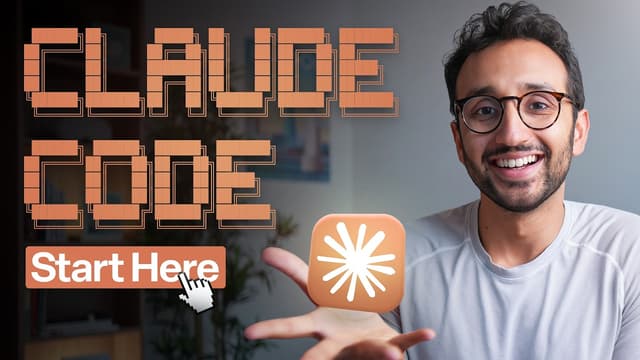
Ali Abdaal's "The Ultimate Beginner's Guide to Claude Code" is commentary positioned very differently from the tech channels that usually cover Claude Code (Tina Huang, Theo, Fireship, etc.). Abdaal is a former NHS doctor, currently a personal-development / business YouTuber with 6.61M subscribers, whose audience is not developers but business owners, content creators, and knowledge workers. For this audience, the hour-long video shows — through concrete business build examples — the change of "someone who used to think the terminal was scary building, in two months, an operational base centered on Claude Code."
What matters from the MEMEX editorial lens is that paired with Tina Huang (Lonely Octopus) on Claude Cowork, this completes the cluster of "Claude platform adoption on the B2C / business owner side." Tina = Cowork; Ali = Code. The audience overlap is real but limited, and Ali's reach is 27 times larger (6.61M vs. Tina's 245K subscribers). A data point that Anthropic's Claude platform — beyond the enterprise / SMB side (Intercom's 1,400-person org doubling velocity, PFF's 200-person post-engineer org) — has spread to concrete production usage on the individual creator / small business owner side as well.
The "AI flywheel" framework — a structure for non-developer progression
The core framework Abdaal articulates at the top of the video is the "AI flywheel." Four steps:
- Have AI interview you about your work — let AI ask, "where in your work, life, business could AI improve things?" — surfacing problems you couldn't articulate
- Let AI propose what to build — propose projects tied to specific value ("saves time / makes money")
- Learn while AI builds — "firmware update for the brain." When technical terms appear during the build (API, MCP, SSH), have AI explain them on the spot
- The learning generates the next build ideas — chain reasoning like "Notion has an API → MCP server → I could build my own MCP server" arises naturally
What matters about this framework is that it does not treat technical learning as a goal in itself. Not "watch a YouTube tutorial and study," but "the technical knowledge you need comes naturally as you solve operational problems." This is an individual-level concrete implementation of the argument in Karpathy's Software 3.0 / Agentic Engineering that "the abstraction layer is going up by one step." The arrival point in the era where non-developers can build production-quality operational systems, because the abstraction layer rose.
Setup — two prerequisites
The concrete setup Abdaal presents for a non-technical audience:
- Download the Claude desktop app — "not the web version (claude.ai), the desktop app." The desktop app has three tabs (Chat / Cowork / Code), which is the starting point that breaks the perception "AI = the web chatbot"
- Install voice-input software — Abdaal uses Whisper Flow A macOS voice-input app Abdaal recommends in the video (around 01:48). Triggered with fn + spacebar, runs speech-to-text with a few hundred milliseconds of latency, and inserts directly into any text field. Abdaal: 'typing is too slow for long conversations with AI.' The video description includes an affiliate link, explicitly disclosed by Abdaal, indicating a possible contractual relationship with the recommended product. Industry adoption and the co-usage rate among Claude Code / Cursor users are not confirmed in primary sources at the time of writing. . fn + spacebar to trigger, speech-to-text in a few hundred milliseconds. "Typing is too slow for long conversations with AI"
With just these two, the "entrance to Claude Code" opens. No prior knowledge of terminal / git / npm is required.
Step 1: "Ask the AI what to build" — live
In the video, Abdaal actually types into Claude: "My current AI skill is using ChatGPT / Claude chat. But rather than tracing a tutorial, I want to learn by building something that actually helps my work and life. Interview me with questions." Claude draws out Abdaal's business — content (YouTube / Instagram / LinkedIn), LBA (online business school), software products (VoicePal, Super Focus, Creator Grid).
When Abdaal says "my team is spending many hours a week on data scraping (YouTube / Instagram / LinkedIn analytics, competitor tracking)," Claude proposes a specific project: "Use the YouTube API to pull competitor data from 50 channels → dashboard → AI tags trending topics." It also adds a meta-level judgment: "This is perfect for learning Claude Code — real API calls, real data processing, including any front end, but on a scale that won't get stuck for days."
What Abdaal emphasizes at the editorial level is the opening lead quote: "Claude achieved in a few exchanges a level of clarity that the automation consultants I paid $50,000 to in the past never achieved." A concrete example on the individual creator / small business owner side of the productivity jumps on the enterprise side seen in Brian Scanlan (Intercom) on 2x dev velocity in 9 months or Mike Spitz (PFF) on 25x deploys in 2 months.
"Have Claude explain every term you don't know" — the learning loop
Abdaal's rule: every time a technical term appears during a build (API, MCP, HTTP, SSH, OAuth), have Claude explain it with history and background included. The video shows the API example — Claude starts from "in 2005 we screenshotted MapQuest and pasted it" and walks through the lineage from packet networks → TCP/IP → HTTP → web → API.
Abdaal also shares his SSH learning: "During the Cold War, the U.S. military feared bombing of telephone exchanges and invented packet communication → TCP/IP → HTTP → World Wide Web → hacking grew → a Polish student developed SSH → over-commercialization → OpenSSH." Understanding this history, "what 'SSH' in the terminal means" clicks, and you can use it without fear when needed.
The key is that you learn while building, not by watching tutorials. The moment "MCP server" appears, Abdaal chains thought — "Notion has an API → there's an MCP server too → I could build one myself" — generating the next build idea (custom MCP server). This is the core of the flywheel.
Ali Abdaal's OpenClaw agent ecosystem — Harry Potter naming
OpenClaw agent An AI agent tool Abdaal references in the video (around 14:48). Abdaal calls it 'Claude Code on steroids,' says he has used it for two months, and that he runs a set of agents (Albus / Hermione / Kaladin, etc.) accessible via Telegram. Abdaal himself states (around 17:09 in the video) that 'security risk is higher than Claude Code,' and recommends beginners start with Claude Cowork / Claude Code and migrate to OpenClaw after getting comfortable. The video does not explain functional specifics (OSS or commercial, file access scope, distribution format, MCP support detail). The only primary source is this video; official docs / OSS repositories etc. are not confirmed in MEMEX at the time of writing. is built into Abdaal's overall operations, and the video introduces a set of Harry Potter-named agents:
| Agent name | Role | Runtime |
|---|---|---|
| Albus | Primary OpenClaw agent (general purpose) | Sonnet / Opus |
| Hermione | LBA curriculum architect (course design) | Sonnet / Opus |
| Minerva | LBA vice principal (operations automation; works with Claude Code) | Sonnet / Opus |
| Remus | Content buddy (content ideation on Telegram; competitor dashboard integration) | Sonnet / Opus |
| Dobby | Cheap personal assistant (simple daily tasks) | Haiku (low cost) |
| Cedric | Relationship coach (family, date ideation with his wife, etc.) | Sonnet |
| Kaladin | Health coach (personal trainer substitute, with DEXA scan history, 5 years of workout history, and injury data) | Sonnet |
The Kaladin case is especially concrete: Abdaal has a history of a left radial head fracture, and when his usual personal trainer is on vacation, Kaladin stands in. He talks to it on Telegram in the gym, and when he says "my groin hurts," Kaladin adjusts the lifts. A concrete example of operating an AI with context of "medical data + workout history + personal state" as a personal coach — a life-level implementation of the boundary Anthropic Glasswing and others discuss between "AI safety and sensitive data."
Eight operational implementations — Claude Code builds across LBA and content
Systems Abdaal implemented with Claude Code over two months:
- Support ticket pipeline — each of LBA's 200 students has a private Slack channel; messages there are auto-ticketed, 24-hour-response SLA is monitored, and a web dashboard visualizes the priority for coaches
- Slack bots for students — Dumbledore (DM agent — takes a LinkedIn profile as input and writes outreach messages; 100+ students have sent thousands of messages), Lupin (LinkedIn agent), Sprout (sales agent), Flitwick (delight agent — supports customer experience design). All bots store conversations in a SOC 2 compliant database, auditable by coaches
- Daily competitor analytics Slackbot — every morning, aggregates the previous day's videos from 50 YouTube competitor channels (title, thumbnail, view count), and auto-flags outliers (e.g., a specific Alex Hormozi video at 94K views in 24 hours)
- Creator HQ (web dashboard) — analyzes 9 years of Abdaal's own YouTube / Instagram / LinkedIn / TikTok / Twitter content, extracts trending patterns, and runs content ideation from workshop transcripts
- Custom MCP server — a structure where Claude / ChatGPT always have access to Abdaal's current projects, goals, outstanding to-dos, and journal items. Context auto-updates each time he uses Claude Code / OpenClaw / Claude
- Replacing custom GPTs with Slack bots — two problems ("students bearing the burden of moving across platforms" + "coaches not being able to audit custom GPT conversations") solved by "equivalent bot functionality within Slack + internal storage of conversation logs"
- Security skills — installing DCG (Destructive Command Guard) A skill that physically blocks the execution of destructive commands (rm -rf, git push --force, etc. — commands involving file deletion or state destruction) against Claude Code / OpenClaw. One of the security best practices Ali Abdaal references in the video, and the first line of defense when a non-developer operates Claude Code. Often discussed in combination with attack surfaces like prompt injection. , prompt injection mitigations, OpenClaw's "third security tier," and so on
- Telegram bot integration — making all OpenClaw agents one-on-one available over Telegram, so agents operate even when away from the PC
The important commonality across these eight is that none are learning-purpose toy projects — they are all in production. LBA's 200 students send messages to Dumbledore daily; Abdaal's team checks the competitor Slackbot each morning to inform content decisions. This is an individual-level implementation of "the tennis rally with the LLM" that Granola's "Cannot one-shot it" describes.
Security awareness — an unavoidable topic even for non-developers
Abdaal spends time on security in the latter half of the video. He states plainly: "Claude Code can delete files on your computer; OpenClaw is more powerful, so the security risk is higher too." Mitigations:
- Understand the concept of prompt injection An attack against LLM-based agents / chatbots. Malicious instructions hidden in third-party text (web pages, emails, documents) are read by the agent, causing it to take actions against the original user's intent (leaking sensitive information, executing destructive commands, etc.). All frontier labs including Anthropic continuously research defenses; full defense is not yet established. Individual-level mitigations include (a) treating input from untrusted sources carefully, (b) introducing two-stage defenses like destructive command guards, (c) restricting the scope of sensitive data passed to the agent.
- Install skills like DCG (Destructive Command Guard) for two-stage defense
- "Don't have it do everything at once — build in stages, verifying behavior at each step"
This security conversation shows that the enterprise / national-level discussion in Anthropic Glasswing or Lawrence Jones (Incident.io) on AI SRE is becoming basic knowledge at the individual user level.
Editorial reading — implications for MEMEX's B2C / business owner axis
Three perspectives MEMEX takes on this video.
(1) Anthropic's B2C / individual creator strategy has arrived. With Tina Huang's Cowork explainer (Cowork = for non-developers) and this article (Code = developer-leaning, but Abdaal operates it as a non-developer), Anthropic's deep penetration into the "non-developers can put Claude into production usage" target layer can be confirmed. Abdaal's 6.61M audience is a layer distinct from Claude's prior primary customers (developers, enterprise).
(2) The "AI flywheel" framework is the B2C counterpart to the generation argument. Karpathy's Software 3.0 / Agentic Engineering and Mike Spitz's post-engineer engineering org were the engineer-side generation argument; Abdaal's AI flywheel frames the non-engineer-side "learn while building" structure. Against the backdrop of a 30% drop in entry-level SE openings and 9/10 graduates worried about AI-related employment (economic conditions for the Class of 2026), it functions as "a concrete methodology for individuals to reclaim agency."
(3) "Telegram + OpenClaw agents with Harry Potter names" as a personal operating system. Operating seven agents by role, holding medical data and five years of workout history as context, conversing via Telegram while away from the PC — this composition is an early implementation of "an AI agent fleet as the individual's operational OS." Abdaal discloses the full setup publicly, positioning it as the "individual edition" alongside enterprise agents like Viktor (an AI colleague who lives in Slack). Many knowledge workers may move in the direction of assembling similar personal agent fleets going forward.
Video outline (main points only; full video about 1h 7m)
- (00:00) Intro — "Claude Code changed my life in 3 months; this is a video to send to friends, family, team"
- (00:38) Explanation of the AI flywheel framework
- (01:30) Prerequisite 1: the Claude desktop app (three tabs: chat / cowork / code)
- (02:00) Prerequisite 2: Whisper Flow voice input
- (02:30) Step 1: "have AI interview you about what to build" — demo begins
- (03:00) Abdaal explains his business — content, LBA, software products (VoicePal, Super Focus, Creator Grid)
- (04:00) Articulating the operational problem — time consumed by data scraping
- (05:00) Claude proposes the project — a YouTube API-powered 50-channel competitor dashboard
- (07:55) "The clarity automation consultants paid $50,000 in the past never achieved"
- (08:30) Hostinger sponsor (intro to Horizons + VPS)
- (09:30) Demo: have Claude explain "what an API is"
- (10:30) The learning chain from API → MCP server
- (11:00) "My personal experience of understanding SSH" — Cold War packet communication → TCP/IP → HTTP → SSH history
- (13:00) Introduction to Ali's OpenClaw agent ecosystem — Albus / Hermione / Minerva / Remus / Dobby / Cedric / Kaladin
- (15:30) Kaladin's personal trainer substitution example (DEXA + 5 years of workout history + injury data)
- (17:00) Walking through eight operational implementations — support ticket pipeline, the LBA Slack bots (Dumbledore / Lupin / Sprout / Flitwick), competitor analytics, Creator HQ, custom MCP server, Slack bots replacing custom GPTs
- (22:00) Security awareness — DCG, prompt injection, staged builds
- (Onward to ~67 minutes) Claude Code terminal basics, file system operations, git integration, step-by-step build demo
Related resources
- Tina Huang (Lonely Octopus) on Claude Cowork
- Brian Scanlan (Intercom) on 2x velocity in 9 months
- Mike Spitz (PFF) on post-engineer org
- Karpathy on Software 3.0 / Agentic Engineering
- Granola's "Cannot one-shot it"
- Viktor (Slack-resident AI colleague) — the enterprise version
- Profile: Ali Abdaal