Hugo Santos (Namespace CEO) · 10:00 "The time to merge becomes the deciding factor — we need a new architecture. There are no PRs. We start from intent and plan."
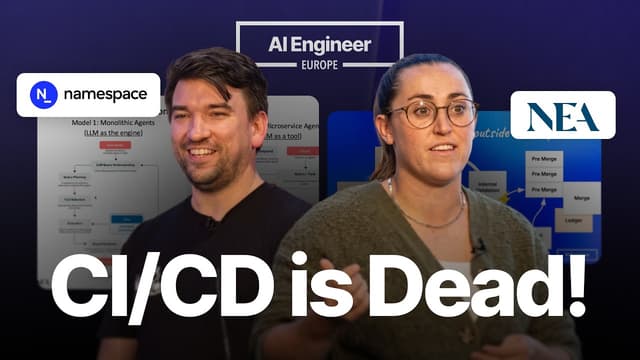
AI Engineer Europe 2026 Day 2 in London, Fleming Room 12:40 – 1:00 pm. The speakers are Hugo Santos (Namespace co-founder and CEO, formerly Google microservices) and Madison Faulkner (NEA partner, formerly Meta AI researcher). NEA led Namespace's Series A of $23M in March 2026 — meaning this is the combination of investor and product lead declaring, together, "CI/CD is dead — next is continuous compute."
Thesis: the CI/CD pipeline designed on the premise of "one human / 1–2 PRs per week" (GitHub Actions / human review / merge queue) literally breaks in the agent era. Holding up a GitHub activity surge graph (commit counts and lines of code jump vertically in a short period), Madison narrates the quantitative change in the problem and Hugo narrates the architectural solution — a division of labor by design.
Key Observations
PRs no longer exist — a new architecture starting from intent and plan (10:00)
Hugo paints the future: "There are no PRs (No PRs)." The starting point is intent and plan, codified somewhere (Linear ticket, Slack, spec — anywhere). From there an agent harness (Claude Code, AMP, Cursor, Factory, etc.) enters the loop — from a well-known commit checks out, uses repo assets, builds + tests for internal verification, then asks the human "continue?" "Continue is the word I use most right now," Hugo says.
Even so, it's still slow. Because a human sits in the external validation step. Over weeks-to-months, humans will be removed from there. Separate agents (security-specialized LLMs, API-conformance LLMs, etc.) handle review, results return to the main harness for immediate fixes, and a stateful environment retains memory + state while absorbing signals from the world (plan changes, conflicts with other commits). Ultimately the pre-merge queue (candidate groups not yet in the repo) maintains serializability; the human's final approval shifts to "intent and result, not code."
The multiverse-era inner loop — agents work on multiple commits at once (15:35)
Further out, in a world where the inner loop becomes extremely fast, the agent's working base is no longer "the latest commit of the repo." Candidates exist in multiples, and agents handle the same plan across multiple commits at the same time. This is the stage of "stepping into the multiverse." Resource consumption explodes, but exploring each candidate in parallel results in net speed.
Hugo calls this "obsessed with performance and efficiency, no unnecessary work, never starting from zero." Agents need to operate incrementally like an engineer working on a personal workstation. This is the basis of Namespace's product thesis — "five layers (caching + orchestration + identity + retries) that overlay on top of existing GitHub Actions and accelerate it."
Mitchell Hashimoto: "Rebuild GitHub for the cloud era" (06:18)
For grounding, Madison cites HashiCorp founder Mitchell Hashimoto's proposal. To fix GitHub, drop Copilot, rebuild for the cloud era, serve AI / agent users first, enable inference at scale, build friendly code storage — that kind of thorough reconstruction is needed, the argument goes. She presents it as social proof that "the industry's top engineers are already sharing the same problem awareness."
Madison says outright that "CI/CD vendors that don't get past this now will die." The move from monolithic agents (the pattern of using an LLM as a single engine) to microservices with agents (a network of role-separated agents) is happening. The GitHub activity surge has already begun. CI/CD alone has not caught up — that is the diagnosis.
"You were the agent" — humans were the first loop (07:21)
Hugo's pivot point of recognition: "You as a human, you are the agent." When a human engineer made a PR, holding a stack of mind, the PR-format violation looped back, a test failure looped back, the human reviewer's "wrong API" looped back, a merge-queue conflict looped back — all along, we unknowingly operated as "human-scale slow agents."
Because of this insight, the agent version requires the same loop structure (intent → plan → harness → checkout → validate → review → merge), but the latency of each step has to drop by orders of magnitude — otherwise, against the volume of PRs, merge time becomes the serial bottleneck and everything jams. This is Namespace's central problem statement: "performance acceleration in an era where the time to merge becomes decisive."
Video Outline
- (00:00) Introductions (Hugo is delayed, Madison goes first) — NEA / Namespace
- (01:22) Why agentic software breaks traditional CI/CD
- (01:53) Monolithic agents → Microservices with agents
- (02:23) Grounds for saying CI/CD is "dead"
- (02:57) Difference between human-scale and agent-scale on PRs per PR
- (03:48) Presentation of the GitHub activity surge graph
- (04:30) The starting point of the solution = acceleration of the inner loop
- (05:18) Cache + Orchestration five-layer structure
- (06:18) Mitchell Hashimoto "rebuild GitHub" citation
- (07:21) "You were the agent" — humans were the first loop
- (10:00) New architecture — no PRs, intent + plan + harness
- (12:00) Acceleration of the inner loop — internal verification builds + tests inline
- (13:36) External validation — separate agents review
- (15:35) The multiverse — agents work on multiple commits at once
- (16:50) CI doesn't die — it just shifts
- (17:58) Summary of Namespace's problem awareness