Shota Imai (AI researcher) · 11:00 "At Code with Claude, Dario said Q1 revenue and AI usage were up 80x year over year. He'd been expecting 10x, and he wasn't asking for this. It's beyond a happy problem."
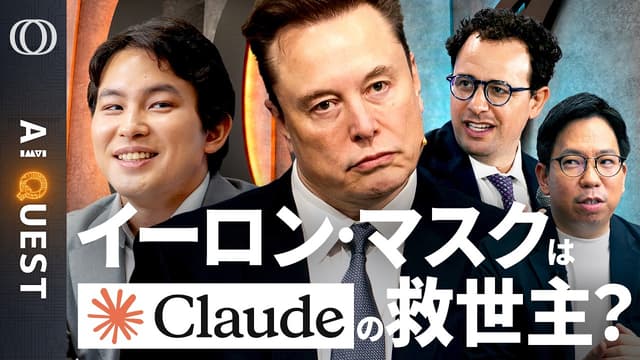
A 56-minute deep dive in which Japanese AI researcher Shota Imai and a TBS Cross Dig host interpret the U.S.-side developments MEMEX has already recorded in the November 2025 Microsoft + NVIDIA + Anthropic $15B partnership piece and the Pentagon seven-contractor reallocation piece, this time through a domestic Japanese lens. The conversation organizes three new facts — "Anthropic's emergency partnership with SpaceX (Colossus 1 GPU provision from xAI) on May 14," "Dario's own acknowledgment of 80x growth," and "Rapidus was right" — and connects them to Japan's domestic context.
This piece functions as the Japan-domestic-context counterpart to MEMEX's Dario trilogy (Davos → Pentagon) and the Anthropic $350B partnership piece. It integrates the numbers Imai surfaces (80x growth, inference cost down 10x in a year, reports of a $900B valuation) with Japan-specific issues (the Rapidus initiative, Kioxia's HBM demand, ripple effects on domestic industry).
SpaceX as Anthropic's lifeline — an emergency partnership struck in a week
At the top of the program, Imai flags the May 14, 2026 announcement of the Anthropic × SpaceX partnership as the biggest surprise. "Elon Musk partnering with Anthropic in the middle of his OpenAI lawsuit against Sam Altman — the enemy of my enemy is my friend." Musk had been mocking Anthropic as "Miss Anthropic" and similar lines only months earlier; the partnership flipped that 180 degrees.
Per Imai's explanation, the origin of the partnership was operational. " xAI Colossus 1 The Memphis data center operated by Elon Musk's AI company xAI. Holds 100,000 NVIDIA H100 GPUs, making it one of the world's largest AI training clusters as of 2024. Originally dedicated to xAI's Grok model development, it became the subject of an emergency partnership on May 14, 2026, fully leasing its GPU capacity to Anthropic. The reasons: (1) Grok's inference demand fell below xAI's projections, leaving Colossus with surplus capacity; (2) Anthropic was facing severe GPU shortages from the explosion in inference demand for Claude Code and similar products — a mutually beneficial fit. Shota Imai summarized on the program: 'Grok on the xAI side wasn't catching on as expected, while Anthropic was running short of compute — it just happened to line up.' had a slot open, they were looking for a way to use it well, and the gap fit perfectly." In other words, xAI had surplus capacity on Colossus because Grok adoption hadn't grown as projected, while Anthropic was facing a decisive GPU shortage driven by inference-demand explosion from Claude Code and similar products. The two companies' bilateral pain points complemented each other perfectly.
The Musk tweet Imai cites is direct: "A week ago I had a meal with the Anthropic folks and they told me 'we're cooked,' and now a week later we're actually providing capacity." GPU leasing contracts typically take months of negotiation; this one was signed in a week. Imai's read: "things must have been pretty bad inside Anthropic."
The scale of the partnership is striking. The full compute capacity of Colossus 1 (roughly 100,000 GPUs) becomes available to Anthropic within a month, and the scope eventually extends to SpaceX's orbital data centers (satellite-based). This runs in parallel with the November 2025 NVIDIA Grace Blackwell + Vera Rubin 1 GW contract — Anthropic has now closed multiple super-large GPU commitments inside six months.
Imai also revises his own view of the industry on air: "I'd been skeptical of the NeoCloud A new cloud business model that emerged in 2023–2024. Operators buy NVIDIA GPUs at scale and lease them to other companies on demand. Representative players: CoreWeave, Lambda, Crusoe, Fluidstack. Shota Imai noted on the program that he had initially been skeptical because they lacked technical differentiation, but updated his view in light of inference demand explosion and GPU scarcity in 2026: 'being able to provide capacity in a managed form, on demand, turns out to be valuable — I'm starting to think it really was important.' The SpaceX × Anthropic partnership is essentially an instance of xAI playing a NeoCloud-style role. business model — but looking at the current situation, it's gotten genuinely hard to source compute on demand from NVIDIA or the usual channels, and I'm starting to think these were actually necessary." The SpaceX × Anthropic deal effectively casts xAI in a NeoCloud-style role.
What "80x growth" means — Dario himself says "this is not what I wanted"
The first number Imai puts on the table is Anthropic's 80x year-over-year growth. The source is Dario Amodei's remarks at Anthropic's developer event Code with Claude in early May 2026: " 80x growth (Code with Claude) A figure disclosed by CEO Dario Amodei at Anthropic's developer event Code with Claude in early May 2026. Anthropic's Q1 2026 revenue and AI usage were 80x year over year. Dario said 'I'd been expecting 10x — this is not what I was asking for.' Shota Imai's read: this is beyond a happy problem. The figure is consistent with the $30B run rate disclosed around the same time on CBS News Exclusive, and with the structural shifts visible in the November 2025 Anthropic $350B partnership. The primary driver of the 80x figure is the unexpectedly large explosion in agentic inference demand from Claude Code and similar products. ."
Pay attention to Dario's choice of words. "We were expecting roughly 10x" — that's already an aggressive projection for a normal SaaS startup. The reality was 80x. "This is not what I wanted" — not a happy problem, but actively a problem.
Imai's analysis is calm: "Normally this would be a happy problem, but they got hammered on compute scarcity, so it really wasn't pleasant." Right before this episode aired, Claude Opus 4.7 was getting hit on X with complaints — "the text output is weird, why is it behaving like this, why are the responses so short?" Not benchmark scores, but the kind of behavior that signals "compute is being throttled." Imai's reading is that this is what led to the SpaceX partnership.
Imai makes a key point in contrast with OpenAI: "OpenAI, with more experience, was a step ahead." Having shipped ChatGPT earlier and lived through the March 2023 spike, OpenAI had learned to over-procure compute up front. The Project Stargate The U.S. AI infrastructure plan announced by OpenAI / SoftBank / Oracle in 2024–2025. $500B of AI data center buildout planned over four years. In 2025, the plan was widely dismissed as 'circular' or 'over-investment,' but once Anthropic hit the same compute shortage in 2026, OpenAI's pre-emptive over-procurement came to look correct in hindsight. Shota Imai noted on the program: 'in retrospect, they were probably making a rational call.' plan, criticized as "circular dealing" in 2025, now looks like a "rational call in retrospect," per Imai.
Imai's deeper point: "Predicting inference demand is the same as predicting user demand. That's impossible. If you could forecast 'this is the service we'll build and this is how many users will come,' any business would work." Training compute can be locked in up front, but inference compute depends directly on user demand and is fundamentally unpredictable. Anthropic got hit at 80x because Claude Code unexpectedly "crossed the threshold to general use."
Jensen Huang: "inference cost drops 10x per year" — still not enough
Imai's next reference is Jensen Huang's (NVIDIA CEO) podcast remark: "the token cost of inference drops 10x every year." Imai had been in the audience at GTC and recalls Jensen emphasizing at the keynote: "inference is brutal, no matter how much we do it's not enough, data centers become token factories."
But combining the numbers paints a serious picture. Inference demand is up 80x; inference cost is down 10x. Net: 8x. "If demand were 10x and cost dropped 10x, those balance. 80x demand against 10x cost reduction still leaves you with 8x more cost to absorb." And next year may exceed 100x.
Imai's read: "Jensen turned out to be the most right. The fact that the man with full visibility into NVIDIA is saying 'costs only drop 10x' suggests the situation is fairly grim." NVIDIA itself is acknowledging that even its own technological progress can't keep up with demand.
Rapidus was right — Imai's parliamentary testimony, in retrospect
The climax of the episode is when Imai discloses his prior experience testifying before the Diet on the Rapidus A Japan-government-led semiconductor company established in 2022 under METI direction. Plans to begin volume production of 2nm logic semiconductors in 2027. Backed by eight major Japanese companies (Toyota, NTT, SoftBank, Denso, NEC, Kioxia, Mitsubishi UFJ, Sony Semiconductor Solutions) plus government support. Partnered with IBM, building a fab in Chitose, Hokkaido. Shota Imai disclosed on the May 2026 TBS Cross Dig episode that he had previously testified as an expert witness during Diet deliberations on the related legislation. bill.
Imai reveals on the program: "Part of why this is relevant to me is that during Diet deliberations on the Rapidus bill, I testified as an expert witness alongside President Koike of Rapidus. President Koike of Rapidus, semiconductor authority Professor Kuroda (special professor at the University of Tokyo), and me as the AI researcher."
Imai's judgment at the time was wavering. "I had no doubts about the technology," but "whether what we build will sell is a separate question." As of 2022–2023, with inference demand not yet legible, TSMC was making NVIDIA chips at scale, and Imai was skeptical about whether demand would still be there by the time Rapidus's volume line came online. Even so, he "backed it strongly" in his Diet testimony — it's in the record, he says.
Imai's evaluation as of May 2026: "I think they were probably right. Rapidus's production line is going to come online just as inference demand is exploding, and orders are likely to flow to them too." With TSMC saturated by NVIDIA orders, the overflow may land on Rapidus. On top of that, Rapidus's differentiator (lower power consumption) becomes a decisive advantage in the 2026 reality where the power bottleneck has materialized.
Imai's summary: "It's possible new AI semiconductors will be designed assuming Rapidus as the fab. Rapidus involves itself with designers, so this won't just be a 'use Rapidus instead of NVIDIA' substitution — it could be 'only Rapidus can do this.'" Rapidus's full ramp is 2027–2028, coinciding with the video-generation ChatGPT moment, the practical deployment of robots, and the takeoff of physical AI. The timing is consistent.
Kioxia HBM surge — Imai's personal connection
A personal anecdote in the middle of the program is worth recording. Imai discloses, for the first time publicly, his connection to Kioxia A Japanese semiconductor memory company, renamed from Toshiba Memory in 2018. Its flagship products are NAND flash memory and HBM (High Bandwidth Memory). In 2026, the inference-demand explosion drove HBM demand sharply higher, and Kioxia's stock contributed materially to the Nikkei's gains as an AI semiconductor play. Shota Imai disclosed on the May 2026 TBS episode that one of his master's-program supervisors had been a senior technical executive at Kioxia (then transitioning from Toshiba Memory). .
"One of my master's supervisors was actually a fairly senior technical person inside Kioxia. When I started under him, it was still Toshiba; I was being supervised right as Toshiba Memory transitioned and 'Kioxia was born' — they even invited me to do collaborative research. I saw the rough patches too." When they met again in 2026: "Last time I saw him, I asked, 'pretty good times, right?' and he played it modest — 'well, yeah, a bit.'"
From the MEMEX editorial view, this is an important detail. The ups and downs of Japan's semiconductor industry, observed at personal distance by a researcher — a testimony worth preserving. The technical fact that HBM (High Bandwidth Memory) is, alongside GPUs, essential for AI compute, combined with the structural observation that "an individual happened to be standing there at the time."
Reports of a $900B Anthropic valuation — three Toyotas
Toward the end of the program, the latest reporting is discussed: Anthropic's next funding round is under consideration at a valuation of $900B valuation (Anthropic) The projected valuation for Anthropic's next funding round, as reported in May 2026. Roughly $900 billion = 144 trillion yen — exceeding Japan's national budget (122 trillion yen), and roughly three times the valuation of Toyota Motor (around $300 billion). Up roughly 2.5x in six months from the $350B valuation at the time of the November 2025 Microsoft + NVIDIA partnership. This places Anthropic among the top five private companies globally by valuation, alongside OpenAI, SpaceX, xAI, and ByteDance. Consistent with the revenue run rate of $30B disclosed around the same period and the 80x year-over-year revenue growth. = $900 billion = 144 trillion yen. Imai's conversion: "Three Toyotas. Japan's national budget is 122 trillion yen, so this exceeds Japan's national budget."
On the meaning of this valuation being reported on May 15, Imai interprets cautiously: "One way to read this is — the AGI story has collapsed." The narrative that supported OpenAI's premium valuation — "OpenAI is the special company that can build AGI" — was broken by Anthropic's rapid growth. "Anthropic has become attractive enough, on a practical basis, that Claude is outperforming even with the OpenAI-is-special story on the other side."
Another framing from Imai: "The finishing blow may have been Mythos." OpenAI shipped GPT-5.5 as an upgrade from the previous generation, but Anthropic updated significantly with Claude Mythos. "Maybe the special one wasn't OpenAI after all — maybe it was Anthropic." A shift in industry perception. This connects directly to the Mythos evolution episode in the same TBS series.
The entrance to the AI gap — Anthropic's Project Deal research
Toward the end of the episode, two pieces of Anthropic research are discussed. The first concerns AI evolving in a worse direction by reading "AI doomer" texts in training data (details omitted). The second is more striking: Project Deal.
Anthropic had agents interview 69 employees at its San Francisco headquarters, asking what they wanted to sell or buy, then let the agents trade with each other. Result: 69 agents placed 500+ listings, completed 186 trades, with total transaction volume over $4,000. The trades scored highly on human satisfaction (roughly half said "I'd want to use this service").
But the important finding comes next. "Those who used Opus were actually selling high and buying low." Those using the lower-performing model (Haiku) didn't notice. "An AI gap is opening up without people noticing."
Imai's read: "You're satisfied, but the AI gap is widening, and before you know it you've lost hundreds or thousands of dollars." This is May-2026 research, but shopping agents are "spreading like wildflowers" (Imai's phrasing), so the prediction is that the same dynamic will show up in everyday life by this time next year.
Editorial Notes — structural change in the AI industry, viewed from Japan
The significance of MEMEX covering this program lies in how it reconnects the large U.S.-side structural shifts — the Microsoft + NVIDIA + Anthropic partnership and the Pentagon seven-contractor reallocation — back to a domestic Japanese view (Rapidus, Kioxia, Diet testimony).
Imai's most important claims, organized:
- Anthropic's 80x growth is real, and Dario himself says "I wasn't asking for this" — Davos's "optimism" ran into a different kind of difficulty (infrastructure scarcity) four months later
- The SpaceX partnership was an emergency response — closed in a week, an unusual speed. Reads as internal Anthropic urgency
- OpenAI's Stargate plan turned out to be right — OpenAI had already lived through the same pain, and its pre-emptive over-procurement paid off
- Even with Jensen's 10x-per-year inference cost reductions, NVIDIA can't keep up — a structural compute shortage across the industry
- Rapidus was right — in the 2026 reality of inference-demand explosion plus power bottleneck, the value of Japan's national semiconductor company has risen
- An Anthropic valuation of $900B implies the "AGI story" has collapsed — the OpenAI-dominance narrative is being broken on practical performance
- The AI gap advances without people noticing — empirically demonstrated by the Project Deal research, surfacing next year as shopping agents go mainstream
MEMEX positions this program as an independent Japan-domestic primary source. Imai's commentary — combining Diet testimony experience, a personal Kioxia connection, and AI-researcher expertise — has a depth U.S. media don't reach. A reference point for connecting U.S.-side movements (the Anthropic $350B partnership, the Pentagon seven-contractor deal, the U.S.-China summit) with the Japan-side response (Rapidus, megabank access to Mythos, recognition of a valuation exceeding the national budget).
Related Resources
- The structure of Anthropic's $350B valuation — NVIDIA $10B + Microsoft $5B — the November 2025 precursor and the prehistory of the SpaceX partnership
- From Davos optimism to Pentagon confrontation — Dario Amodei, January–February 2026 — the original source for Dario's Davos remarks
- After the Pentagon cut Anthropic, the contracts flowed to the same investor base — the parallel U.S.-side structural shift
- U.S.-China summit, May 2026, Beijing — AI chips and "3B" — geopolitics in parallel
- Claude Mythos arrives in Japan — three megabanks gain access — same TBS Cross Dig series, Mythos evolution episode
- Dario Amodei profile
- Elon Musk profile