Mark Pike (Anthropic AGC) · legal demo 01:54 "I'm checking because my name goes on the reply, and trust but verify is pretty much the whole job."
The one takeaway across these three demos: Cowork is designed not as an "AI assistant" but as a substrate for accumulating workflow corpus — and the 7-stage workflow is identical across roles (legal / marketing / sales). Anthropic's strategic axis isn't individual tools but the "skill file" as a unit.
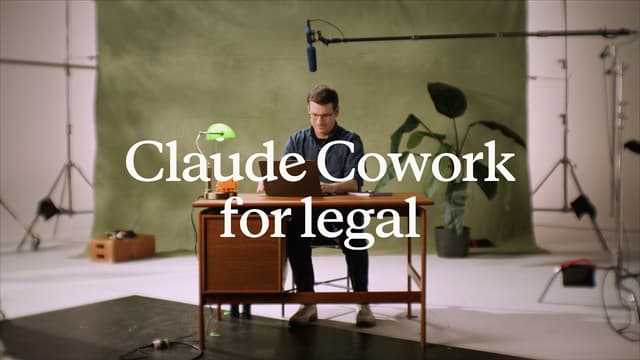
The editorial significance of this three-part series is that Anthropic put forward, in parallel across three axes (legal / marketing ops / sales), the user personas it imagines for Claude Cowork A local AI agent product Anthropic launched for macOS on January 12, 2026 (Windows on February 10, 2026). It runs on the user's desktop, with a three-layer extension architecture: connectors (Slack / Gmail / Salesforce / JIRA, etc.), skills (reusable instruction files), and plugins (vertical bundles). Where Claude Code agentifies developers' work, Cowork agentifies knowledge work for roles like legal, marketing, sales, and finance. The official tagline is 'Claude Code for the rest of your work.' . It pairs with Tina Huang's B2C / individual-user perspective and represents directly the "B2B knowledge worker" persona Anthropic envisions.
From the MEMEX editorial view, the important point is the shared architectural pattern across all three demos. The same 7-stage workflow — "scheduled morning task + skill invocation + data gathering via connector + synthesis via skill + human review + corpus accumulation" — recurs across all three roles. This is evidence that Anthropic is designing Cowork not as a single "AI assistant" but as a platform for the skillification A MEMEX-coined structural concept. Workflow knowledge gets written down as reusable text files (skills) and handed to Claude — anyone can replay the same workflow. Unlike traditional automation scripts (macros), it can be expressed in something close to natural language. The design principle Anthropic's Claude Cowork puts forward, treating the 'individual knowledge → organizational knowledge' transition at the granularity of skill files. of white-collar work.
Demo 1: Legal — Mark Pike (Anthropic AGC) on his morning briefing
Mark Pike is an in-house product lawyer at Anthropic (Associate General Counsel). The premise of the demo is typical:
- Morning. A product manager pings on Slack with a "quick question" about a feature launched a few months ago
- Only a few minutes until the next meeting
- The context from when the memo was written has been fully lost
- The old workflow would have meant "spending the first hour rereading your own past work"
Mark's Cowork setup: a scheduled task runs first thing every morning, delivering today's brief as a "personalized chief of staff." Gmail inbox is connected via connector. Five today-due items are shown — 2 routine, 1 new, 1 follow-up (this morning's PM question).
Mark's most-used skill is /brief. "A plugin built on the workflow of Anthropic's own legal department," Mark explains — and one published as an open protocol, "customizable to your own playbook." Triggered by /brief + product name + the specific change, the skill already knows:
- Where review files are stored
- The structure of the internal templates
- How to search related Slack / Gmail threads
The output format is structured to match Mark's thinking order: "the conclusion at the time" → "what's changing now" → "which part of the analysis it affects." Instead of "finding 3 paragraphs in a 40-page memo," the brief "points you at those 3 paragraphs" — with the cited earlier-review paragraph reachable verbatim.
Mark emphasizes the philosophical core: "I'm checking because my name goes on the reply, and trust but verify is pretty much the whole job." For a lawyer, verifying AI output isn't optional — it is the job. Cowork's role isn't to skip the verification, but to compress the busy work that comes before it (file search, rereading old memos, rebuilding the thread).
After the work is done: Claude drafts a reply to the PM → Mark approves → the internal JIRA ticket gets closed. Mark's framing for the core: "building out a corpus of knowledge so that anybody in the legal department or, if needed, the rest of the company can access that information instead of building information silos." Beyond individual productivity, Mark places shared corpus inside the department and across the company front and center (read by MEMEX as an intent to build an "organizational knowledge graph").
Demo 2: Marketing Ops — Ian's weekly metrics review
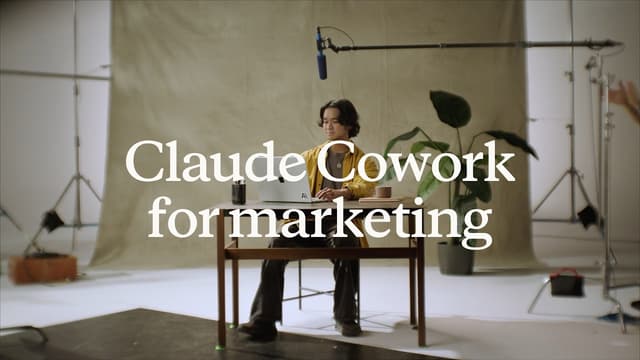
Ian (first name only, marketing ops + analytics) has a typical job: every week, produce a detailed doc for the marketing team plus a one-slide summary for leadership. The old workflow involved manually pulling from half a dozen data sources — 30–60 minutes of work.
Ian's Cowork workflow uses three skills:
- Prep skill — pre-review preparation, data pull, focus-area suggestions
- Proofread skill — verifies that every number in the doc is traceable to a verified source
- Action items skill — registers follow-ups in Asana
A scheduled task fires Sunday night: reads last week's review and meeting transcripts, checks the sales team's focus on Slack, queries the data warehouse. Monday morning, Ian says "Good morning, Claude. How did the prep go?" and receives ready-made takeaways plus a suggested focus.
The week-by-week judgment (narrative steering) stays on Ian's side: "this is a quarter turn, so let's lead with the team's Q2 plans," and he drops in the QBR doc. The prep skill's behavior during the demo is important: when "the sales team did a tiny reorg and the reporting structure no longer fits," Claude doesn't guess — it flags the discrepancy and asks. Ian says "follow the sales team," and Claude carries the update forward. This is the verify step from Tejas Kumar's harness framework, embedded into the natural-language flow.
The proofread skill's role is verifying the origin chain of numbers: it ensures every figure in the draft can be traced back to a verified data source. The first pass is metrics table + headlines only; after the outline is confirmed, Claude expands details (under the strict rule that headlines don't change). When the draft is complete, Ian says "ship it," and Claude finalizes the doc plus generates the Slack-channel announcement.
An important closing: at the end of the demo, Ian asks Claude, "what should we add to next week's skill based on what we learned this week?" The sales team's new structure, the corrections Ian made — they all get folded back into the skill file, and the skill itself is versioned up. "Because it's a skill, you can share it with the team, and anyone can get the same result." This is the B2B-implementation counterpart of Pedro Rodrigues's three skill-design principles — skill as work protocol.
Demo 3: Sales — Brittany's account brief plus post-meeting flow

Brittany (first name only, a growth account executive) manages a strategic startup-account portfolio. Before a first meeting with a customer, she needs to know fast: "who they are, what they're building, how they're using Claude, what their spend looks like, what the risk and growth signals are." The information is scattered across Salesforce, the data warehouse, call recordings, Slack, email, and the web.
Brittany walks through her process for building a skill from scratch:
- Open a Cowork session and describe in natural language what she wants to know "when walking into a meeting"
- Claude drafts a skill file from that conversation (turning the natural-language instructions into text)
- What's in the skill file: which data sources to reference, which usage signals matter, how to present the results
- Pre-wire connectors in settings: data warehouse, Salesforce, web, email, Slack
- Point at a desktop folder as the read / edit / save destination
- Test on a test account and refine
- Because the skill file is plain text, she can open it herself and verify "what Claude is doing"
Live use: /account-strategy-builder + "Acme Corp." Claude pulls in parallel: last-90-days calls, revenue trend, open opportunities in Salesforce, related email / calendar, Slack, funding / web news — synthesizes it all into a strategy doc and saves it to the account folder. The output is a full account brief: spend information, stakeholder mapping, the Claude models the customer is building, open deals, risk signals.
After the meeting: the same Cowork session retains the account context, so she triggers /call-transcript-processor. It pulls the transcript and produces three outputs:
- Personal action items for Brittany
- An internal Slack message (key takeaways, next steps, action owners)
- A follow-up message to the customer
Each output requires Brittany's approval before being sent (human-in-the-loop built in). A 30-minute post-meeting flow shrinks to a few minutes, and it's "more thorough than going from memory."
The 7-stage architectural pattern shared across the three demos
The three roles look like different jobs on the surface, but MEMEX reads the Cowork workflows as sharing a common structure:
- Scheduled task — proactive prep runs in the morning (legal, marketing) or in advance (sales account prep)
- Data acquisition via connectors — pulled directly from existing systems: Gmail / Slack / Salesforce / data warehouse / JIRA / Asana
- Triggered via skill files — everything starts from a slash command (
/brief,/account-strategy-builder,/call-transcript-processor). Skills are plain text and human-readable - Parallel data collection + synthesis — gathered in parallel from multiple sources, formatted to a role-specific template
- Human review (trust but verify) — every deliverable passes through an approval gate. Quoted material is verbatim and traceable to the source
- Write-back to external systems — closing JIRA tickets, posting to Slack, creating Asana tasks, sending customer emails
- Corpus accumulation / skill improvement — what was learned (a sales team reorg, customer-specific context) is written back into the skill file itself, improving subsequent workflows
What this 7-stage pattern reveals is Anthropic's strategic hypothesis: "white-collar work looks different role by role, but the architectural pattern is shared." So a single Cowork substrate, with plugins (vertical bundles) swapped in, can cover legal / marketing / sales / finance in one product.
Editorial Notes — reading "skill files" and "workflow corpus"
From the MEMEX editorial view, this three-demo series is readable as Anthropic's business-strategy document.
(1) The skill file is being put forward as the unit of workflow knowledge. Plain text, shareable, versionable, directly verifiable. Workflow knowledge that used to be trapped in Word macros, Excel templates, Salesforce Process Builder, or Marketo programs is now consolidated into a single general-purpose format (the skill file). Mark's "I helped build this plugin based on how Anthropic's own legal department works" is a sign of dogfooding — Anthropic's own work protocols going straight to market.
(2) Functional overlap with role-specific SaaS is observable in the demos. From a viewer's perspective:
- Legal demo → overlaps in scope with legal-specific tools like Ironclad, Spellbook, Harvey
- Marketing ops demo → overlaps with Marketo, HubSpot dashboards, Salesforce Marketing Cloud Reports
- Sales demo → overlaps with Outreach, Salesloft, Gong (call transcripts), Clari (forecasting)
Anthropic doesn't say in the demos that it will replace these SaaS. But once the functional overlap is observable on-screen, there's room for viewers to read "Cowork + connectors + skill files might do the equivalent work." MEMEX reads it that way. Alongside the engineering-side shift Niklas Gustavsson framed as "coding constraint → product decision constraint", the white-collar side is showing signs of considering a shift from "point-solution SaaS" to "integrated agent + skills." Whether this materializes is something to watch over the next 6–12 months.
(3) The implications of "open protocol." Mark's "it's open protocol — any of you can open it up and custom tailor it" signals that skills are plain text and modifiable by third parties. This extends Anthropic's official Skills proposal and reads as a step toward a plugin marketplace. Where existing SaaS could only be extended through APIs, the design now permits extension via skill files written close to natural language.
(4) The intent to build workflow corpus. From Mark's "building out a corpus of knowledge ... instead of building information silos," MEMEX reads Cowork's differentiator as the design that "accumulates customer-company workflow corpus inside Cowork," rather than the quality of the underlying AI. The more skills version up and the more connectors embed into the customer's existing systems, the higher the switching cost to a competitor — that structural lock-in is implicit.
Video Outlines
Legal demo (Mark Pike, around 2m 59s)
- (00:00) Self-introduction, Anthropic in-house product lawyer
- (00:18) Morning Slack ping — "quick question about a feature from a few months ago"
- (00:37) Cowork's scheduled morning task and the "chief of staff" metaphor
- (00:47) Gmail inbox connector, sorting through 5 today-due items
- (01:00) How to invoke the
/briefskill - (01:09) Built on "Anthropic's own legal department workflow," published as an open protocol
- (01:43) Output format: prior conclusion / what's changing / where it lands
- (01:48) Navigation from 40-page memo to the 3 relevant paragraphs
- (01:54) "Trust but verify is pretty much the whole job"
- (02:13) Using the brain for strategic thinking is the point of law school
- (02:30) Drafting the PM reply, closing the JIRA ticket
- (02:42) Building a corpus of knowledge — not creating information silos
- (02:51) Closing — "lawyers being asked to do more with less"
Marketing Ops demo (Ian, around 3m 35s)
- (00:00) Self-introduction, marketing ops + analytics
- (00:24) Weekly metrics review (team doc + leadership one-slide)
- (00:34) Cowork's role: data pull + verify; narrative steering stays with the human
- (00:40) Three-skill structure (prep / proofread / action items)
- (00:52) What runs in the Sunday-night scheduled task
- (01:11) Starting Monday morning with "Good morning, Claude"
- (01:34) Quarter turn → leading with Q2 plans, drops in the QBR doc
- (01:42) Prep skill flags a data inconsistency and asks (no guessing)
- (01:56) Sales team reorg changes the reporting structure
- (02:11) Proofread skill: trace every number back to a verified source
- (02:22) First pass headlines only; details after the outline is confirmed
- (02:43) "Ship it" → doc finalized + Slack post generated
- (03:00) Action items registered in Asana
- (03:09) Leadership slide generated (from the same data and narrative)
- (03:15) "Write this week's learnings back into the skill"
- (03:30) Skill update + team share
Sales demo (Brittany, around 3m 32s)
- (00:00) Self-introduction, growth account executive, startup portfolio
- (00:17) Five information requirements before a first meeting
- (00:31) Enumerating the scattered data sources
- (00:45) Live build of the skill from scratch
- (00:57) What goes in the skill file (data sources / signals / format)
- (01:08) Pre-wiring connectors in settings
- (01:20) Refinement on a test account, plain-text verifiability
- (01:29)
/account-strategy-builder+ "Acme Corp" - (01:51) Parallel data pull (call / revenue / Salesforce / email / Slack / web)
- (02:05) Strategy doc synthesis, saved to account folder
- (02:13) Output examples: spend / stakeholder / model usage / open deals / risk
- (02:35) After the meeting, transcript processing via
/call-transcript-processor - (02:52) Three outputs: personal actions / internal Slack / customer follow-up
- (03:09) Each output passes through an approval gate
- (03:14) 30 minutes → a few minutes; more thorough than from memory
- (03:27) Closing — higher-quality customer conversations
Sources
- Claude Cowork for legal teams (Anthropic official Claude channel, published May 18, 2026)
- Claude Cowork for marketing ops (Anthropic official Claude channel, published May 18, 2026)
- Claude Cowork for sales (Anthropic official Claude channel, published May 18, 2026)
- Cowork: Claude Code power for knowledge work (official product page)
- Artificial Lawyer: Mark Pike interview
- Claude for Legal teams webinar (Mark Pike + Maggie Russo)
- Fortune: Big Law goes all in on AI with new Anthropic release
- LawSites: 20+ connectors and 12 practice-area plugins
- Mark Pike LinkedIn