Stephen Chin · 02:33 "Gartner just added context graphs to the AI hype cycle. Foundation Capital sized it as a $3 trillion entrepreneurial opportunity. This is escape from the matrix."
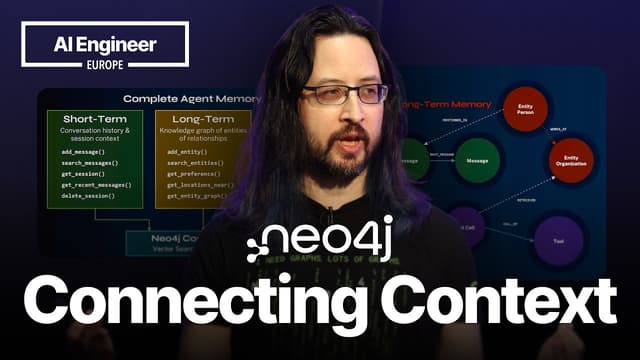
Stephen Chin's AI Engineer Europe 2026 talk is a positioning statement from the largest graph-DB company on the contours of the new category Gartner officially added to its 2026 "AI hype cycle": the Context Graph. More than a technical intro, it confirms that "LLM × knowledge graph" is now industry consensus as a differentiator for AI products.
From the MEMEX editorial view, what matters is that this crystallizes — from the graph-DB side — the same "context management is the core of AI products" industry consensus that runs through Sally-Ann Delucia (Arize) on Hierarchical Memory and Leonie Monigatti (Elastic) on Agentic Search for Context Engineering. For MEMEX itself — which puts a network graph at the core of the product — the philosophy overlaps directly. An important node.
"We are trapped, escape the matrix" — defining the problem
Stephen's framing: "As engineers, we're trapped. We think we're using AI coding tools — but our PRs are being reviewed by the agent. We're not in control. The tool is." This echoes Karpathy-line arguments — the recognition that "the master / servant relationship of control is inverting."
The direction for the solution: "choose the red pill and escape the matrix." Concretely, move from today's world — where knowledge is scattered across Slack conversations, enterprise systems, and customer threads — to one where everything is connected on a context graph. If we're going to delegate business decisions to agents, this is required infrastructure.
With Gartner's and Foundation Capital's recognition, the context graph has moved out of the experimental phase. Foundation Capital's "$3 trillion market" estimate reflects an industry judgment: as the layer providing "grounded, complete information" that an LLM alone or RAG alone cannot reach, the context graph is essential.
Three retrieval levels — a medical use case for comparison
Stephen presents a concrete comparison. The query: "what is the care plan for Andreyi Jenka's emphysema?"
- (1) Baseline LLM — a generic answer from emphysema general knowledge ("preventing lung damage," etc.)
- (2) RAG (vector search) — some patient context enters, getting more specific: "respiratory therapy, deep breathing exercises"
- (3) Context Graph — "medication management, smoking cessation counseling, pulmonary rehabilitation" — specific, considering the patient's smoking history and past surgical history
With RAG, "background information" gets flattened by similarity search and drops out. A graph holds relationships as first-class objects, preserving the multi-hop path "this patient → past diagnoses → past surgeries → smoking history." That makes a decisive difference in the reliability of production agents.
Integrating three memory layers on a knowledge graph
The core of a Context Graph is a design that manages agent memory in three layers:
| Layer | Role | Examples |
|---|---|---|
| Short-term memory | Current execution context, conversation state | Recent tool call results, in-progress plan |
| Long-term memory | Domain model, entities, past interactions | History of customers / products / past decisions |
| Reasoning trace | The basis for "why this decision was made" | Compliance audit, debugging, learning material |
The importance of the reasoning trace — LLMs normally return only "the result," but accumulating reasoning in a graph enables "pulling past similar decisions to produce improved future decisions." This directly connects to the requirement that surfaces repeatedly in Anthropic's alignment discussions — "AI with provenance for its decisions."
The implementation is the Neo4j Agent Memory Package (open source, on GitHub). ACID-compliant persistence, APIs for short / long / reasoning memory, and graph traversal exposed in a form easy for an agent to call.
Two implementation demos
Demo 1: Lenny Memory Podcast (open source) — converts all episodes of Lenny Rachitsky's podcast into a knowledge graph. The agent queries the graph via tools, plots "locations that appeared in an episode" on a map, and traces episodes connected by a given topic. Turns a dense information source — time-sequenced, multi-speaker, with conceptual chaining — into a "navigable structure."
Demo 2: Financial services context graph app — a loan approval use case. Entities (individuals / organizations) + events (decisions / transactions / approvals) + context (applicable policies / risk factors / prior reasoning) stored in a graph. Ten MCP tools integrate the support ticket system, CRM, and internal business data. Asked "should Jessica Norris's loan be approved?", the agent walks the graph, discovers "past rejection" and "margin trades relationships," and returns a decision accompanied by concrete reasoning + risk factors + past comparable cases. "Auditable / explainable" emerges naturally from the graph structure.
Editorial Notes — what Context Graphs mean for MEMEX
Three angles from which to read this talk on MEMEX.
(1) Direct overlap with MEMEX's own methodology. MEMEX's network graph treats people / companies / events in the AI domain as nodes, with relationships as edges, fueled by articles. This matches the three-layer "entity + relationship + reasoning trace" structure Stephen describes. MEMEX can be repositioned as "the context graph for AI journalism."
(2) The end of RAG and the standardization of graph + LLM. Through mid-2025 the atmosphere was "RAG is enough," but entering 2026, three viewpoints — Sally-Ann (Arize) on observation, Leonie (Elastic) on retrieval, and Stephen (Neo4j) on databases — converged simultaneously on "context flat-out breaks; graph structure is needed." This is the technical inflection point for the industry. Read alongside Sally-Ann's Hierarchical Memory discussion.
(3) A direct answer to enterprise's "auditable AI" requirement. The "AI that can explain why it decided what it decided" requirement that keeps surfacing — in Anthropic Glasswing's safety discussion, in Japan's three megabanks adopting Claude, and elsewhere — is naturally satisfied by a context graph structure. Directly aligned with regulatory requirements like the EU AI Act, Japan's AI guidelines, and the U.S. NIST CSF.
Video Outline
- (00:00) Self-introduction, Neo4j DevRel
- (01:30) "We are trapped" — the matrix metaphor
- (02:33) Gartner recognition + Foundation Capital's $3 trillion estimate
- (03:20) Basic knowledge-graph structure (nodes + relationships + embeddings)
- (04:30) Complementarity of LLM and graph (language + knowledge)
- (05:30) Three-level retrieval comparison on a medical use case
- (08:00) Three memory layers explained (short / long / reasoning)
- (10:00) Introducing the Neo4j Agent Memory Package
- (10:30) Demo 1: Lenny Memory Podcast
- (12:30) Defining a context graph application
- (13:00) Demo 2: financial services loan review
- (16:30) Graph Academy + free learning resources
- (17:00) Close — "escape the matrix"