Eric Schmidt · 04:00 In the years after we graduated, not one of us set out determined to build technology that would polarize democracy and destabilize the young. That wasn't the plan. But that's what happened.
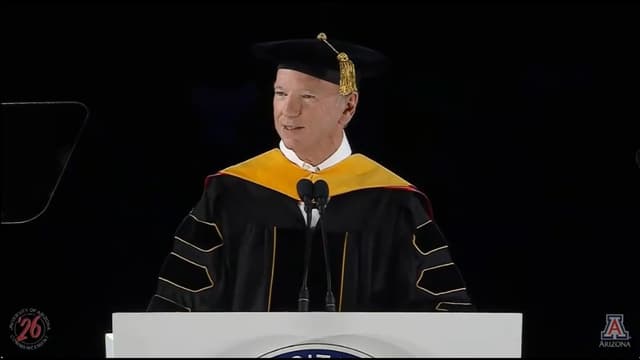
Eric Schmidt's University of Arizona commencement speech, after the WSJ clip of the boo went national, was framed almost entirely as "the architect of AI policy rejected by students." Listened to in full, the 16 minutes are a radically different artifact — Schmidt publicly acknowledges that the technology of his own generation (the PC-era optimists of 1982) ended up polarizing democracy and destabilizing younger generations, and on that basis asks the Class of 2026 to "choose differently." A self-critical address.
The MEMEX editorial reason to cover this speech is to preserve the signal that lies on the far side of the narrow "boo controversy" framing. Schmidt's self-criticism is historic as an acknowledgment of "the failures of the prior generation" from inside the US AI policy establishment, and is likely to be cited repeatedly in future AI policy debate. At the same time, the structural backdrop — the Class of 2026's economic position (5.7% unemployment, entry-level software engineering postings down 30%) — sits alongside it; both are stored together in a single article.
1982 and 2025 — Schmidt's self-criticism bridges two Time Persons of the Year
Schmidt earned his doctorate in 1982. That same year, Time chose for the first time a non-person as Person of the Year — the personal computer. Schmidt was researching that machine in graduate school and recalls: "we were going to change the world." Over the next 40 years, the bulky machine with green text on a black screen became the laptop, the smartphone, the internet, social media, the cloud, and finally "the supercomputer vibrating in your pocket right now."
Schmidt describes the optimism of the 1980s like this: "It felt as if we were adding a stone to the cathedral of knowledge humanity had been building for centuries. We genuinely believed that connecting every person on Earth and making all the world's information shareable was unambiguously good."
Then Schmidt's rhetoric reverses. "But the world we built turned out to be far more complicated than we predicted. Tools meant to connect us also isolated us. Platforms where everyone had a voice degraded the public square, rewarded outrage, and amplified our worst instincts. They coarsened how we speak to each other, how we treat each other, and the texture of society itself."
Then the heart of the self-criticism (04:00):
"In the years after we graduated, not one of us set out determined to build technology that would polarize democracy and destabilize the young. That wasn't the plan. But that's what happened." (Eric Schmidt, 04:00)
Coming from a central figure inside the US AI policy establishment, this public acknowledgment of "the failures of the prior generation" is notable. From a position distinct from both the discourse of the Anthropic Glasswing safety community and Silicon Valley tech optimism more broadly, Schmidt is explicitly acknowledging what his generation's tools ended up breaking.
Immediately after this self-criticism (04:12) Schmidt cites Time's 2025 Person of the Year — The architects of artificial intelligence The title of Time's December 2025 Person of the Year. Not a single individual but a group — OpenAI's Sam Altman, Anthropic's Dario Amodei, Google DeepMind's Demis Hassabis, NVIDIA's Jensen Huang, and others driving AI as an industry. Schmidt uses this selection as a rhetorical device, bridging it with Time's 1982 pick (the first-ever machine Person of the Year, the personal computer, named the same year he earned his doctorate) to compare two generations of technology builders. . The 43-year gap between 1982 (the PC) and 2025 (the AI architects) is a deliberate rhetorical bridge, functioning as the device for the message "my generation failed; I'm asking you to choose differently." The moment of this 2025 citation triggered the first round of boos.
Where the boos happened — locating them inside the full speech
The 2-minute clip the WSJ published is 12.5% of the full speech, a framing that selectively cuts together the boo moments (mainly the 2025 Person of the Year citation at 04:12, the "don't surrender your agency" pivot at 05:42, and the subsequent comparison of AI to past technology revolutions). The remaining 14 minutes are structurally different — four practical pieces of advice for the Class of 2026, optimism about science, and a closing on "your humanity is not a handicap; that's the entire point."
Schmidt's central claim in the boo moment was (05:42 – 05:49):
"Speaking as if the future has already been decided is to surrender the only thing that really matters. You're surrendering your own agency. The future doesn't simply arrive. It's built in laboratories, in dorm rooms, in startups, in classrooms, in legislatures. And the people who build it are you, and people like you." (Eric Schmidt, 05:42)
The boos grew louder during this pivot. The next round came when Schmidt compared AI to earlier technology revolutions (the steam engine, electricity, the internet). Add up the three boo moments and the total occupies under a minute of the full speech — about 6%. The remaining 94% is constructive.
The Class of 2026's economic position — the structural backdrop to the reaction
The backdrop to the rejection of Schmidt's "have the agency to build the future" appeal is the concrete economic situation facing the Class of 2026. Figures cited across coverage:
- 5.7% unemployment among recent graduates (Q4 2025, the highest in four years)
- 6.1% unemployment among computer science graduates (Federal Reserve Bank of New York, nearly twice the rate for philosophy majors)
- Entry-level software engineering postings down 30% year over year (Handshake, 2025)
- Junior-level postings down 7% year over year
- Nine out of 10 graduates are concerned AI will replace entry-level jobs
- Only one in three students feels their university prepared them to use AI
- 35% of entry-level postings already require AI skills
This is the mirror image of Marlene Mhangami's (Microsoft & GitHub) AI Engineer Europe 2026 chart showing a 14x surge in GitHub Octoverse commits. Over the same period that commits on GitHub rose 14x, entry-level software engineering postings fell 30%. The corporate-side productivity jumps — Intercom doubling its development speed in nine months, PFF hitting 25x deploys and 10x output in two months — show the structural channel by which those gains flow directly into entry-level hiring.
Schmidt's optimism — science and the U Arizona Stewart Observatory
From the middle of the speech onward, the tone is optimistic. Schmidt lists concrete examples of AI accelerating science:
- Protein folding — a 50-year unsolved problem solved by AI in months
- Next-generation antibiotics — emerging from the same line of work
- Next-generation cancer therapies — same line
- Clean energy materials — same line
- "What we're seeing is only 1% of what's coming"
Here Schmidt inserts a localized note of praise — at the University of Arizona's Stewart Observatory, Dr. Genuzzi's team is building a telescope more powerful than Hubble. "Research that will change our understanding of the universe is happening, right now, in this stadium in Tucson." A rhetorical gesture intended to connect with the audience, and consistent with Schmidt Sciences' investment in space science.
Schmidt's metaphor: "When you're offered a seat on a rocket, you don't ask which seat. You just get on. Graduates — the rocket is here."
Four practical pieces of advice
The latter half of the speech is built on practical advice:
- Find a way to say yes — to invitations, to new cities, to projects beyond your current capabilities. "The people I respect most in their 20s are the ones who chose yes."
- Build a team — citing his longtime coach, the late Bill Campbell A legendary Silicon Valley executive coach (1940–2016). Coached the CEOs of many tech companies, including Apple, Google, Intuit, and Amazon. Eric Schmidt was coached by Campbell throughout his career and co-authored 'Trillion Dollar Coach: The Leadership Playbook of Silicon Valley's Bill Campbell' (2019). Campbell's well-known line — 'Work the team, then work the problem' — is one of the central pieces of advice Schmidt cited in his University of Arizona commencement speech. : "Work the team, then work the problem"
- Fail quickly and pivot without shame — "the frontier only exists at the edge of 'this might not work.' The people who accomplish the most aren't those who avoided failure; they're those who stopped being embarrassed by it."
- Bet on yourself — "the world gives you many reasons to discount your own intuition. Don't. Your intuition about what matters most to you is the most valuable signal you can own. Trust it."
"What do I bring?" — judgment, conscience, perspective, moral sense
The section immediately before the closing (around 12:30):
"The models will keep getting more powerful. The question you'll face, again and again, is: what do I bring? The answer: you bring judgment. You bring conscience. You bring perspective. You bring the moral sense of what is worth building, and what is not. The scientist who decides which questions to ask — that's you. The architect who decides what to design — that's you. The citizen who decides what kind of country we become — that, always, is you." (Eric Schmidt, 12:30)
This passage runs parallel to the industry thesis articulated in Karpathy's Software 3.0 / Agentic Engineering vision — that the engineer's role shifts from writing code to setting spec and judgment. Schmidt's version emphasizes the ethical and social dimensions of the individual's role in "deciding what is worth building."
The 22-year arc of Carlos Scarpa — a personalized generational handoff
Schmidt names a specific graduate: Carlos Scarpa, a computer science major. Schmidt's explanation: "Carlos's father missed my 2004 commencement speech — because Carlos was being born that very day. Tonight, his father is here, watching his son step into a new future where the builders always outrun the bystanders."
Schmidt frames this 22-year arc — a father who missed Schmidt's 2004 speech, a son born that same day, a son now hearing Schmidt as a U Arizona graduate in 2026 — as "a simple implementation of generational handoff." "To Carlos and his classmates: protect your humanity. Not abstractly — concretely. In the small decisions about what you build, how you build, and who you build it for."
"Your humanity is not a handicap. That's the entire point." — the close
The strongest line of the closing (14:10):
"Your humanity is not a handicap. That's the entire point. [AI] is not taking the future from you. It's offering you a larger future than any prior generation was ever offered. The question now is what you do with it." (Eric Schmidt, 14:10)
Then a personal close. "When you reach my age and look back 50 years, what you'll care about isn't grades or salaries or titles. It's friends. The person who picked up the phone, the mentor who believed in you, the partner you shared a life with, the team that built something no one thought could be built."
A final reflection: "Happiness is not the same as joy. Happiness derives from meaning. Meaning in the work, meaning in relationships, meaning in your place in the world, meaning in a purpose that drives you. Find it, and the rest takes care of itself." And he closes with: "the future is not finished — now it's your turn to shape it" (15:30).
Eric Schmidt's particular position — NSCAI and the core of US AI policy
The content of the speech can't be understood apart from its political context. Schmidt is not simply a former Google CEO.
- Google CEO (2001–2011) — the core executive who built the search-advertising business and grew Google into a global company
- Chair, US National Security Commission on Artificial Intelligence (NSCAI) (2018–2021) — the AI national-strategy advisory commission established by the US Congress. The commission's NSCAI final report (2021) The 756-page final report submitted by the US National Security Commission on Artificial Intelligence to the US Congress in March 2021. Its central argument: 'the US faces the risk of falling behind China in AI and should invest in AI competitiveness as a national strategy.' It systematized national AI policy budgets, military AI applications, semiconductor and talent strategy, and allied coordination. Eric Schmidt chaired the commission, and the report became the foundation for the later CHIPS Act, the AI Executive Order, and current 2026 policy packages such as the Pentagon's seven-company AI contracts. A symbolic case of a private AI industry figure leading national AI strategy. was a 756-page blueprint for national AI strategy that became the foundation for the later CHIPS Act, the AI Executive Order, and the Pentagon's AI procurement strategy
- Founded the Special Competitive Studies Project (SCSP) (2021–) — successor to NSCAI, run in the private sector; an independent think tank focused on US–China AI competition
- Schmidt Sciences / Schmidt Futures — AI-related philanthropy and investment activity, including investment in space science (the U Arizona Stewart Observatory mention sits in this context)
In short, Schmidt is a core figure who effectively designed the current US AI national strategy. The fact that this person publicly acknowledged "what my generation broke" and was booed in the same speech positions the address not as a standalone commencement but as a political artifact that makes visible the relationship between the US AI policy establishment and the next generation.
Broader trend — a continuing pattern across the 2026 commencement season
Schmidt's case is not isolated. The May 2026 commencement season has seen several similar incidents:
- University of Central Florida (early May 2026) — real estate executive Gloria Caulfield said "the rise of AI is the next industrial revolution" and drew boos from the audience
- Glendale Community College (May 2026) — the chancellor disclosed that "we used AI to read out the graduates' names," and after mispronunciations skipped several names, the audience booed (in this case, the proximate cause was AI's poor performance)
- University of Arizona (May 15, 2026) — Schmidt's speech, the subject of this article
Slate, TechCrunch, and NBC News broadly converged on the observation that "in 2026, mentioning AI in a commencement speech has become a politically risky act." That is a signal that the social framing through 2025 — "AI = exciting frontier" — is, in 2026, being reorganized at the generational level into "AI = a threat to my livelihood".
Adjacent context — Schmidt's personal litigation
As a factual record, MEMEX notes adjacent context: a lawsuit filed in 2025 by Schmidt's former partner Michelle Ritter, which includes allegations of sexual assault. Schmidt has denied the allegations. The matter is independent of this speech, and some student activist groups had also protested Schmidt's commencement appearance itself. Multiple reports record that the main cause of the boos in the venue was AI-related remarks, so the litigation and the AI backlash are kept as separate contexts.
Editorial reading — implications for MEMEX's AI×economy / AI×politics axes
Four angles for covering this speech on MEMEX.
(1) Schmidt's self-criticism is a historic signal. The moment a core figure inside the US AI policy establishment publicly acknowledged "the prior generation's technology polarized democracy and destabilized the young" is likely to be cited repeatedly in future AI policy debate. A similar self-criticism is hard to imagine from either mainstream Silicon Valley tech optimism or the discourse of the Anthropic-side safety community — unique in its origin.
(2) The gap between the WSJ's framing and the full speech. Selective media excerpting raises news value at the cost of obscuring the structural truth (94% of the speech is constructive content). Long-form explanatory publications like MEMEX are in a position to preserve that framing gap. The character of "the boos happened, but they were under 6% of the speech" is itself the differentiator for an editorial publication.
(3) The cognitive gap between "those who build AI" and "those AI is happening to" is real. What matters, however, is that Schmidt himself built that gap into the rhetoric, presenting his bridging of the 1982 and 2025 Time Persons of the Year as self-criticism. More than the fact of the boos, what merits analysis is Schmidt's strategic decision to structure the speech in anticipation of them. This is the political expression of the generational handoff debate that runs in parallel with Mike Spitz's (PFF) post-engineer engineering org and Karpathy's Software 3.0 — the handoff from the 1970s–80s generation to the 2020s generation.
(4) A base node on MEMEX's AI×economy / AI×politics axes. Class of 2026 economic data (entry-level SE postings down 30%, unemployment 5.7%), Schmidt's position at the core of US AI policy, the continuing commencement phenomenon, the 1982–2025 Time PoY bridge — all consolidate into a single node. It will serve as a reference point for tracking shifts in public opinion, the generational dimension of US–China AI competition, and the "politically risky" status of AI references at commencements and public events.
Video outline (full 16 minutes)
- (00:00 – 00:55) Introduction of Schmidt by the host (President Garimella or designated speaker)
- (00:55) Schmidt takes the stage; tribute to Cisco Aguilar (the previous speaker)
- (01:20) Formal opening — thanks to the President, the Dean, the Board of Regents, and the graduates
- (01:42) Recollection of his own 1982 doctorate
- (02:00) Citing Time's first Person of the Year as the personal computer in 1982
- (02:30 – 03:20) 1980s optimism — "the cathedral of knowledge," "connecting everyone on Earth is unambiguously good"
- (03:20 – 04:00) Self-criticism — "the same tools isolated us and degraded the public square"
- (04:00) Core self-criticism: "no one planned to polarize democracy, but it happened"
- (04:12) Citing Time's 2025 Person of the Year, the architects of AI — first round of boos
- (04:25) "We are at the edge of another technological transformation — bigger, faster, with heavier consequences"
- (04:40 – 05:30) The fears of "your generation" enumerated — machines, the disappearance of work, climate, politics
- (05:30) Analysis of how social media algorithms amplify fear
- (05:42) Agency pivot: "to speak as though the future has been decided is to surrender your agency" — second round of boos
- (05:49) "The future is built in laboratories, dorm rooms, startups, classrooms, legislatures"
- (06:00) "The question isn't whether AI will shape the world; it's whether you will shape AI"
- (06:30 – 07:00) The appeal to include perspectives — choosing freedom / equality / immigrants
- (07:00 – 09:30) Optimism — science acceleration, protein folding solved in months, next-generation antibiotics / cancer therapies / clean energy
- (09:30) Tribute to U Arizona's Stewart Observatory and a telescope more powerful than Hubble
- (10:30) The rocket-ship metaphor — "don't ask which seat, just get on"
- (10:40 – 12:30) Four pieces of practical advice: yes / team (Bill Campbell) / fail / bet
- (12:30) "What do I bring?" — judgment, conscience, perspective, moral sense
- (13:00) The 22-year Carlos Scarpa anecdote
- (13:50) "Protect what makes you human" — concretely, specifically
- (14:10) "Your humanity is not a handicap. That's the entire point."
- (14:30 – 15:00) What you'll care about in 50 years — friends, mentors, partners, teams
- (15:00) Final reflection: "happiness ≠ joy; happiness derives from meaning"
- (15:30) Closing: "the future is not finished — now it's your turn to shape it"
Sources
- Eric Schmidt's speech at Arizona University (FULL) — University of Arizona official channel — the 16-minute primary source
- Eric Schmidt met with boos during University of Arizona commencement speech over AI fears — Fox Business
- Former Google CEO Eric Schmidt booed during graduation speech about AI — NBC News
- If you're giving a commencement speech in 2026, maybe don't mention AI — TechCrunch
- Why college graduates are booing commencement speakers across the country — Slate
- By the Numbers: What the class of 2026 job market actually looks like — CNBC
- National Security Commission on Artificial Intelligence (NSCAI) — official site
- Special Competitive Studies Project (SCSP) — official site