Brian Scanlan · 05:50 If you're not using AI — designer, PM, engineer — you're not meeting expectations. It's binary. You have to say the same message 100, 1000 times.
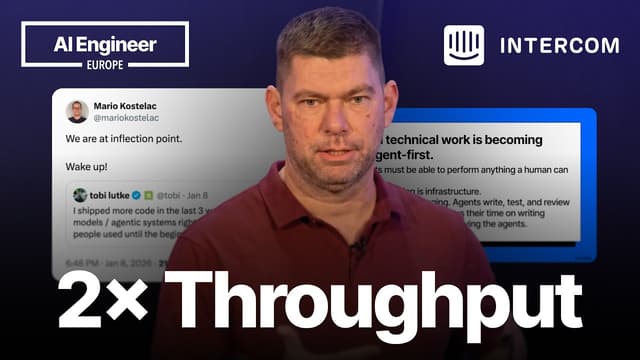
Brian Scanlan's AI Engineer Europe 2026 talk functions as concrete empirical evidence against the industry anxiety that "in the AI era, SaaS dies." Intercom is a 15-year-old Irish-American B2B SaaS that pivoted to AI the weekend ChatGPT came out. Public SaaS company growth is trending down, and Intercom is accelerating growth in the opposite direction (the comparison chart that opens the talk).
Intercom's AI agent "Finn" (for customer support) is, as of May 2026, at 8,000 customers, 2 million resolutions a week, and revenue at roughly the $100M scale. The customer mix — Anthropic, Snowflake, Linear, Glean, and LaunchDarkly all using Finn for their own support — is itself symbolic. Mid-talk, Brian reports: "we recently built our own model — it now handles 100% of Finn's English text conversations, outperforming Sonnet, cheaper / faster / better." An empirical counter from the enterprise side to the Karpathy-line industry argument that "SaaS is dead."
The 2x goal — wildly ambitious and wildly unambitious
In mid-2024, Intercom's leadership set a target of doubling engineering velocity in a year. They named the project and team "2x." The measure is code changes per R&D person. "This is wildly ambitious — but also wildly unambitious, given where models and coding harnesses are going," Brian says. That latter reading is one of Intercom's wins; they correctly predicted the late-2024 Claude Sonnet breakout (the period when an Intercom principal engineer came back from vacation and posted in Slack, "My god, things changed massively") as "a wave coming for the whole industry."
The early trial-and-error matched everyone else's. GitHub Copilot company-wide → all on Cursor → also validating Augment. It capped out at "marginally better, somewhat fun." In December 2024, Brian chose Claude Code as the unified company-wide platform and started the rollout in January 2025. Nine months later, by the end of 2025, PR throughput doubled. Target hit three months ahead of plan.
Platform strategy — not multi-cloud; the compounding gain of one vendor
Brian spends 30% of the talk on the philosophy of platform selection. "Lots of people were adopting Cursor and Augment. We're believers in platforms — which one you pick actually doesn't matter that much, but picking one matters." Same structure as multi-cloud — spreading work across different clouds forfeits the compounding benefit of a well-designed platform.
Intercom's vision is simple. "Treat Claude like a senior engineer who can take on any technical task across Intercom." Anything Brian can do on his laptop, Claude should be able to do. "We're not reckless, of course — we don't let it nuke the database" — but as a mature company with a mature permission / audit / control system already in place, they have the confidence to "unleash Claude the same way we unleash a new hire."
This is the perfect enterprise-side match for the design philosophy articulated by the Claude Code creator in Boris Cherny on Claude Code — "Claude Code isn't autocomplete, it's an agent." Intercom is the large-scale empirical demonstration of the use case Anthropic envisioned.
Onboarding strategy — skills, hooks, plugins at the hundreds scale
If you're treating Claude as a "senior engineer," it needs onboarding. Intercom teaches Claude everything they teach a new hire — Rails conventions, architecture, React patterns, testing standards, security rules. "We've built an enormous amount of software in 15 years; Claude can't do the job without Intercom-specific context."
The implementation is the combination of Anthropic's official Skills + hooks + plugins. Hundreds of contributors and thousands of lines of code have accumulated in Intercom's cloud plugin. Worth highlighting: plugin deployment is Intercom's own — they built an internal mechanism that "bypasses Claude Code's standard update flow and pushes the internal cloud plugin to every laptop." "The time we spent debugging Claude Code installs across hundreds of laptops was enormous — the same hell as managing Python installs across 100 machines." Knowledge that only surfaces on the ground at large enterprise scale.
Self-updating skills are another Intercom hallmark. "A flywheel that updates guidance when something didn't work." Brian's experience: during a recent security incident (Snowflake table metadata accidentally published to a public GitHub repo), he habitually opened Claude Code and asked it to "look at the Slack channel." A skill Brian himself didn't know about — one that encapsulates the company's entire data breach policy — auto-triggered, downloaded the files, analyzed them, and concluded "innocuous" in 2 minutes. A task that would otherwise be 20 minutes of boring work. "Brian only provided the intent; the agent auto-selected the skill" — the on-the-ground implementation of Anthropic's recommended intent-based skill selection.
Implementing "motivation" as organizational change
What's more crucial than the technical content of Brian's talk is the organizational part. "Engineering leadership needs decisions, executive guidance, and organizational change." Concretely, what Intercom did:
- Revised job descriptions: "if you're not adopting AI, you're not meeting expectations as a designer / PM / engineer — it's binary" — made explicit in writing
- Repeated messaging: "say the same message 100 / 1000 times, in every forum" — "constantly talk about the urgency"
- A culture of rewards: "updated a skill, improved a plugin" auto-posted to a Slack channel, celebrated
- Hackathons and AI immersion days
- A standing Team 2x: "put our best people on this full-time; essential for any medium or large org"
Brian's important point: "hey, you got to AI everything, best of luck" — letting it ride — fails. Conscious effort is required to "bring along hundreds of engineers." This fills in Karpathy's Software 3.0 / Agentic Engineering vision claim of "an organization-wide vibe shift" with concrete large-enterprise implementation.
Results — the numbers and the dashboard
Brian published internal dashboard screenshots at AI Engineer Europe. The main numbers:
- PR throughput doubled in 9 months (the target was a year)
- PRs generated by Claude Code are in the 90% range of the total
- Automated code approval rate: 17.6% — confidence levels refined by back-testing and human labels
- SOC 2 / ISO 27001 / HIPAA all compliant — after consultation with auditors, confirmed that "certification can be met without human-in-the-loop"
- Defect closure speed at an all-time high — some teams now aiming for "backlog zero"
- Code quality measurement with a Stanford research group — code quality trending upward
The 17.6% automated approval rate is a number reached while avoiding the prescriptive eval trap Laurie Voss warns about. Brian explains: "we did a lot of work to shape PRs into a safe, simple form" — they changed the design of the PRs themselves so the agent could approve them more easily, an improvement in the reverse direction. The same direction as the vibe-coding production discussion from Sholto Douglas / Trenton Bricken — a dual adaptation of "before trusting the agent, change the organization and the code into something the agent can trust."
A maturity model — the five-stage evolution of an engineer
The internal engineer maturity rating Brian shows is a multi-stage evolution frame:
- Use: use Claude Code for everything
- Automate: automate your own work
- Skill-ize: externalize the automation as a skill
- Skill-writing fluency: get good at writing skills; iterate on skills continuously
- Environment optimization: reshape the software architecture and documentation themselves on the assumption of agents, so the agent becomes even more effective
The last stage is the deepest. "Environment optimization centered on agents" — work that rewrites existing codebases and docs into shapes the agent can use easily. The organizational implementation of "agent-first codebase," running parallel to Granola's "cannot one-shot it" knowledge and the context engineering of agentic search.
"Sysadmin → SRE — the same shift, at 100x speed"
Brian closes with his own career. "Years ago I was a Unix sysadmin — going into the data center to rack servers. The cloud came, and sysadmin → SRE. Work shifted to automation, impact grew, pay went up. What's happening now is the same shift, at 100x speed, across the whole industry."
This metaphor aligns exactly with Karpathy's vibe coding → agentic engineering argument that "the abstraction layer moves up one level." Karpathy speaks of it as an idea; Brian speaks of it as 9 months of empirical data. Two cross-sections of the same vision.
Editorial reading — what the Intercom proof point forces us to decide
Three angles for taking this talk into MEMEX.
(1) A reference value for the SaaS industry's AI adoption speed. Intercom = ~1,400 employees, Rails monolith, 15 years of legacy code. They doubled development speed in 9 months. If SaaS companies at the same scale (HubSpot, Zendesk, ServiceNow, and so on) can't match that speed, the gap in competitiveness becomes structural. A key watch metric for investors and executives going into the second half of 2026.
(2) Claude Code = the established standard as an enterprise platform. In the 2026 coding agent market where Cursor / Augment / Codex coexist, Intercom's case becomes Anthropic's largest sales weapon as a large-enterprise adoption case. Alongside the structure of Anthropic's $350B valuation and Japan's three megabanks adopting Claude, it is the delivery proof point for Anthropic's B2B strategy.
(3) Not "everyone at once" but the "best people from" strategy. Intercom placed its best engineers full-time on Team 2x first, then scaled from there. Exactly the same as Mike Spitz's (PFF) 2-month case study with its "start from the best 2 engineers" strategy. Companies of different sizes, industries, and regions are converging on the same adoption pattern. Evidence that this is becoming the de facto standard for AI adoption in 2026.
Video outline
- (00:00) Intercom introduction; the chart of counter-growth under the SaaS downturn
- (02:00) Finn (customer support agent) scale; in-house model announcement
- (03:00) Brian self-introduction — 12 years, Platform Group, shipping obsession
- (04:00) Origin of the 2x project — goal-setting in mid-2024
- (05:00) Engineering leadership and messaging strategy
- (07:00) Standing up Team 2x; deciding on company-wide Claude Code (December 2024)
- (09:00) Onboarding and plugin deployment — managing hundreds of laptops
- (11:00) All of engineering changes; the shift in abstraction layer
- (13:00) A real-world skill flywheel — the auto-triggered skill during the security incident
- (15:00) The five-stage engineer maturity model
- (16:00) Publishing the internal dashboard — 2x achieved, 17.6% automated approval
- (18:00) Accelerated defect closure; the Stanford code-quality research
- (20:00) Claude Code going viral outside Intercom too; the single-person team experiment
- (21:48) Close: "if you're not doing this yet, you need to start now"