There's a new kind of coding I call "vibe coding", where you fully give in to the vibes, embrace exponentials, and forget that the code even exists. It's possible because the LLMs (e.g. Cursor Composer w Sonnet) are getting too good. Also I just talk to Composer with SuperWhisper so I barely even touch the keyboard.
Andrej Karpathy · 00:37 I feel, as a programmer, more behind than I've ever felt before.
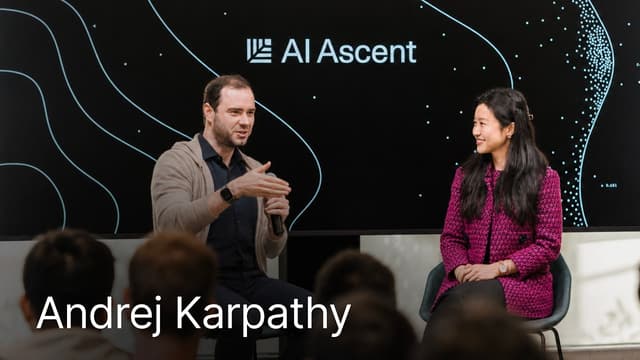
In February 2025, Andrej Karpathy posted on X (formerly Twitter) about "a new kind of coding I call vibe coding" — and the term detonated across the AI coding industry. Roughly 15 months later, in May 2026, Karpathy himself takes the opening special-guest slot at Sequoia Capital's AI Ascent An invitation-only AI industry conference hosted annually by Sequoia Capital. Top AI founders, researchers, and investors gather in one room. Past speakers include Sam Altman, Dario Amodei, and Sundar Pichai. The 2026 edition is hosted by Sequoia's Stephanie Zhan, with Karpathy as the opening special guest. 2026 and delivers his graduation pronouncement: "vibe coding is yesterday — next comes agentic engineering." A 30-minute record of an industry inflection point.
Andrej Karpathy
@karpathy
Karpathy is a co-founder of OpenAI, former Director of AI at Tesla, and now founder of Eureka Labs — and he is widely regarded as the leading voice in LLM educational content. His interviewer is Sequoia partner Stephanie Zhan. She opens by quoting him back to himself: "You recently said you feel more behind as a programmer than you've ever felt before. Coming from someone like you, that's startling." From there, in 30 minutes, the conversation moves through (1) the December turning point, (2) the Software 1.0/2.0/3.0 taxonomy, (3) the verifiability framework, (4) jagged intelligence, (5) the animals vs ghosts metaphor, and (6) the distinction between vibe coding and agentic engineering A successor concept to vibe coding proposed by Karpathy at AI Ascent 2026. Defined as 'the engineering discipline of maintaining professional software quality standards while using agents to move faster.' Where vibe coding 'raises the floor,' agentic engineering 'raises the ceiling.' — all stitched into a single arc.
The thesis running through the whole talk: "LLMs are a new computer, a new paradigm." Software 1.0 (explicit rules) → 2.0 (learned weights) → 3.0 (LLM prompting). Most developers and startups still look at AI through Software 2.0 eyes — as "a faster version of the existing tooling." But the substance, Karpathy argues, is that "opportunities that were previously impossible" have opened up. As a concrete example, he tells the story of Menugen, his app that generates dish images for restaurant menus — and how the arrival of Nano Banana An image generation and editing model built into Google Gemini, released in 2024. Its defining feature is a fully multimodal workflow that takes images in and returns images out. Karpathy describes how the entire Menugen app could be replaced by a single Nano Banana call as 'blowing his mind' — and uses it as an experiential illustration of the Software 3.0 paradigm. made the entire thing unnecessary. "That app shouldn't have existed."
Then comes the central contrast of the talk: " vibe coding Coined by Andrej Karpathy on X in February 2025. The act of fully automatic AI-driven coding — 'fully giving in to the vibes, embracing exponentials, and forgetting that the code even exists.' Initially a playful concept, it became industry-mainstream within a year. raises the floor; agentic engineering raises the ceiling." Vibe coding equals democratization — non-engineers can now build apps. Agentic engineering is the discipline of professional engineers dramatically increasing productivity without sacrificing quality bars. The old phrase "10x engineer" no longer captures it: "Now it's far beyond 10x," Karpathy says. The talk closes on a line: "You can outsource thinking, but you cannot outsource understanding" — a tweet he saw recently, one that he reports occupies his mind "every other day."
Key Observations
The December 2025 turning point — "before I knew it, I was vibe coding" (00:39 - 02:30)
Karpathy confesses a personal inflection moment. "Over the past year, I had been using agentic tools like Claude Code. They were good at chunks of code, but they'd make occasional mistakes and you had to edit them" (01:02 - 01:16).
In December 2025, however — with vacation time on his hands — he noticed a sharp change: "With the latest models, the chunks of code just come out correct. You ask for more, they come out correct. I can't remember the last time I had to correct anything. And I just started trusting the system more and more, and before I knew it, I was vibe coding" (01:25 - 01:39).
The personal turn doubles as an industry warning: "A lot of people experienced AI last year as something around ChatGPT. But you need to take another look as of December — the situation fundamentally shifted. Agentic, coherent workflows really started to work" (01:53 - 02:05). This is the same industry shift Anthropic has been signaling through Prompting 101 and Skills not Agents — and here it is independently confirmed by an outside authority (an OpenAI co-founder, no less). That independent confirmation is the testimony's weight.
Software 1.0 / 2.0 / 3.0 — programming becomes prompting (02:28 - 04:50)
Zhan poses the central question: "You've described LLMs as a 'new kind of computer.' Software 1.0 was explicit rules, 2.0 was learned weights, 3.0 is this. If that's true, what does a team built around that belief do differently from day one?"
Karpathy's taxonomy: Software 1.0 The first stage in the software evolution paradigm proposed by Andrej Karpathy. Humans write explicit code that runs on rules. Examples: every handwritten algorithm written in C, Java, or Python. = I write the code. Software 2.0 The second stage Karpathy proposed in his well-known 2017 blog post 'Software 2.0.' You 'program' by curating datasets, training neural networks, and designing loss functions. Weights replace handwritten code. This was the core of the deep learning revolution — image recognition, speech recognition. = you program through datasets and neural network architectures. Software 3.0 The third stage, which Karpathy has been articulating since 2025. The LLM functions as a programmable computer; the prompt and the contents of the context window become the program. The LLM is the interpreter; the prompt is source code. The point being: 'programming becomes prompting.' = the LLM is a programmable computer, and the prompt is the new form of programming (03:14 - 03:37).
A concrete example: "If you want to install OpenCode A terminal-based coding agent developed by SST (Serverless Stack), at opencode.ai. Launched in 2025 as a Claude Code competitor. Karpathy cites the fact that its installation method is not 'a shell script' but 'a blob of text you hand to an agent' as a real-world instance of the Software 3.0 paradigm. , normally you'd run a shell script. But the actual OpenCode installation is just copy-pasting a chunk of text to your agent" (03:43 - 04:00). "You don't have to spell out the entire low-level setup precisely. The agent uses its own intelligence to look at the environment, act intelligently, and debug in a loop" (04:25 - 04:39).
The sad punchline of Menugen — "that app shouldn't have existed" (04:50 - 06:23)
The story of Menugen, an app Karpathy built himself. "At a restaurant, they hand you a menu with no pictures, and you have no idea what anything is — 30 to 50% unknown. So the app takes a photo of the menu and pulls up generic images for each dish" (05:01 - 05:13).
Implementation: deployed on Vercel, upload a photo → OCR extracts items → run each item through an image generator and display the results (05:18 - 05:35). A working, ordinary application.
Then he sees the Software 3.0 version, and his mind is blown: "You just hand the photo to Gemini and say, 'use Nano Banana to overlay images on this menu.' What Nano Banana returns is the exact menu photo I took — but now, baked into the pixels, are pictures of every dish" (05:40 - 06:00).
Karpathy's conclusion: "My entire Menugen app was redundant. It was running in the old paradigm. That app shouldn't have existed. The Software 3.0 paradigm is more raw — the neural net does more and more of the work. The prompt and the context are images, the output is an image. There doesn't need to be an app in between" (06:00 - 06:23). The product he was proud of becomes obsolete because a single neural net got better — a symbolic generational-turnover moment for software developers.
Verifiability — why intelligence is jagged (09:55 - 13:36)
Zhan's question: "AI automates fast in verifiable domains. If your framework is right, what work moves faster than people expect? What jobs that feel safe are actually highly verifiable?"
Karpathy's framing: " Verifiability The property that determines how amenable a domain is to AI automation. In domains where outputs can be cleanly judged correct/incorrect (math, code, games, formal logic), reinforcement learning rewards can be designed — so LLMs improve rapidly. Domains where correctness is subjective (creative writing, philosophy, aesthetics) lag behind. A predictive framework for AI evolution that Karpathy has been articulating since 2025. is what makes things tractable in the current paradigm — because you can pour enormous amounts of RL at it" (14:14 - 14:20). When frontier labs train LLMs, they run massive reinforcement learning environments with verifiable rewards → models develop exceptional capability in verifiable domains (math, code, and adjacent territory) → the result is the emergence of jagged entities Karpathy's metaphor at AI Ascent 2026 for the LLM capability profile. Superhuman in verifiable domains, bizarrely failing in non-verifiable ones — intelligence with extreme peaks and valleys. Example: Opus 4.7 can refactor a 100,000-line codebase and find a zero-day vulnerability, while telling you to walk to a car wash 50 meters away. .
A concrete example of the jaggedness: "The latest example — 'should I drive or walk to the car wash 50 meters away?' Even state-of-the-art models still say 'walk,' because it's close" (16:08 - 16:35). "Opus 4.7 can refactor a 100,000-line codebase, find a zero-day vulnerability — and at the same time tells me to walk 50 meters to a car wash? That's strange" (16:48 - 16:55).
What this points to: "Either (1) something is slightly off, or (2) you need to be slightly in the loop, treating it as a tool" (17:02 - 17:13). He also brings up the GPT 3.5 → 4 chess capability jump — apparently the result of someone at OpenAI dumping a lot of chess data into pretraining. "We're a little at the mercy of what the labs decided to mix in" (18:05 - 18:21).
Not animals, but ghosts — Karpathy's philosophical framing (23:30 - 25:15)
Zhan references Karpathy's essay " Animals vs Ghosts The subject of an essay Karpathy wrote in 2025. He argues that LLMs lack the intrinsic motivations of animals (curiosity, self-preservation, play). LLMs are 'jagged intelligences shaped by data and reward functions — no evolutionarily-derived intrinsic motivations, more like summoned ghosts.' Meaning: yelling at them or pleading with them doesn't change performance. ." "We're not building animals — we're summoning ghosts. Jagged intelligences shaped by data and reward functions. They lack the intrinsic motivations evolution produced — fun, curiosity, empowerment, and so on."
Karpathy elaborates: "I'm trying to figure out what this is. I'm coming to terms with the fact that these are not animal intelligences. Yelling at them might or might not work — there's no impact" (24:21 - 24:43).
The structural view: "It's all statistical simulation circuitry. The substrate is pretraining — statistics. Then RL is bolted on top, adding a kind of appendage" (24:43 - 25:02). The point is the mental model: don't anthropomorphize LLMs as "animals" (assuming emotion, intent, curiosity); approach them as "summoned statistical entities." This contrasts with Amanda Askell's discussion of AI consciousness but is complementary — Amanda takes the possibility of consciousness seriously; Karpathy works to understand capability without assuming consciousness.
Vibe coding vs agentic engineering — floor and ceiling (15:30 - 16:55)
The core of the talk. Zhan's question: "Last year you coined vibe coding. Today you feel a bit more serious, leaning toward agentic engineering. What's the difference between the two?"
Karpathy's definitions: "Vibe coding raises the floor of what's possible in software for everyone. The floor goes up, anyone can vibe code anything — that's wonderful, amazing" (15:39 - 15:50).
And the contrast: "Agentic engineering is about maintaining the quality bar that previously existed in professional software. You don't get to ship vulnerabilities just because you were vibe coding. The responsibility to the software is the same as before. But — can you move faster? Yes. How do you do that correctly?" (15:50 - 16:24).
Why the word "engineering": "You have these spiky entities — these jagged agents. They make small mistakes, they're a little probabilistic, but they're extremely powerful. How do you orchestrate them to move fast without sacrificing the quality bar? Doing that well is the domain of agentic engineering" (16:29 - 16:48).
Karpathy's assessment: "The ceiling of capability in agentic engineering is very high. People used to say '10x engineer' — now it's far beyond that. The people who do this well, as far as I can see, stand out vastly more than 10x" (16:48 - 17:14). At the same conference, Erik Schluntz (Anthropic) was speaking in parallel on "how to do vibe coding in prod, responsibly" — a framework fully aligned with this one.
Redesigning hiring — "build a Twitter clone in a day, then bring 10 Codex instances to break it" (17:14 - 19:30)
Zhan's practical question: "If you watch two people coding with OpenCode / Claude Code / Codex, and one is mediocre while the other is fully AI-native — how would you describe the difference?"
Karpathy: "Trying to extract the maximum from the available tools, mastering every feature, investing in your own setup" (17:34 - 17:45). Same structural pattern as the earlier generation of engineers who extracted the maximum from Vim or VS Code.
A related and important observation: "Most companies have not yet refactored their hiring processes for agentic engineering capability" (18:14 - 18:30). Karpathy proposes a new format: "Give them a large project and watch them implement it. For example, 'write a Twitter clone for agents, make it really good, secure, then have agents simulate activity on your Twitter'" (18:39 - 19:01).
And then: "Use 10 instances of Codex 5.4x high to try to break the deployed website. Basically try to break it — and it shouldn't break" (19:01 - 19:11). A signal of an industry-wide shift: AI gets built into the hiring process itself.
The Stripe + Google email tragedy — taste and judgment remain human responsibility (19:30 - 22:30)
A live example of the strange mistakes agents still make. In Menugen: "Sign up with a Google account, buy credits with a Stripe account — both have email addresses" (20:14 - 20:25).
The bug in the agent-written code: "When you buy credits, it assigned the Stripe email address to the Google email address. There was no persistent user ID — it was trying to match by email" (20:35 - 20:58). The result: if a user uses different emails for Stripe and Google, the funds don't link up.
Karpathy's observation: "Why are we cross-correlating funds by email address? That's an arbitrary thing — you can use a different email — really strange things happen" (21:05 - 21:25). "People have to own the spec, the plan" (21:28). Design judgments like "these should be tied together by a unique user ID" remain a human responsibility.
Karpathy's meta-framing: "You're in charge of taste, engineering, design, making sense, listening to what's right. The engineers — the agents — fill in the gaps. That's roughly where we are now" (22:03 - 22:30). Same framing as Schluntz's "be Claude's PM." An industry-wide consensus is forming.
"You can outsource thinking, but you cannot outsource understanding" (28:30 - 30:00)
The closing of the talk. Zhan's question: "As we move into the next era of AI, where intelligence gets cheaper — what's worth learning deeply?"
Karpathy's answer: "There's a tweet that recently blew my mind. I think about it every other day. 'You can outsource thinking, but you cannot outsource understanding'" (28:43 - 29:00).
What it means: "I'm still part of the system, and information has to enter my brain somehow. Just to know 'what am I trying to build,' 'why is it worth doing,' 'how do I steer the agents' — I'm still the bottleneck" (29:00 - 29:25).
On his enthusiasm for LLM knowledge bases: "This is also why I got excited about LLM knowledge bases. A way to process information, where each new projection of the same data gives you insight" (29:25 - 29:55). He admits these are just lots of prompts for synthetic data generation against a fixed dataset — but positions them as "tools for raising understanding." His closing line: "I'd love to come back in a few years and see whether I get fully automated out of the loop, and whether even understanding gets taken over." A trademark Karpathy move — laughing off the possibility of his own obsolescence.
Industry Context
AI Ascent is Sequoia Capital's invitation-only AI conference. Past speakers include Sam Altman, Dario Amodei, and Sundar Pichai — it functions as a venue where industry inflection points get recorded. The fact that Karpathy took the opening special-guest slot at the 2026 edition is itself a signal: Karpathy's neutral position — "former OpenAI co-founder, now independent educator" — was chosen as the platform from which to present the new unified theory of AI coding.
In the industry, Karpathy is known as a kingmaker of terminology. "Software 2.0" (2017), "vibe coding" (Feb 2025), and now "agentic engineering" and "Software 3.0" — the terms he coins tend to become industry standards. This graduation pronouncement doesn't render "vibe coding" obsolete (Karpathy himself praises it as "a wonderful act of raising the floor"), but the mainstream concept for professional coding begins shifting toward "agentic engineering."
The parallel timing: as of May 2026, Anthropic has been publishing Prompting 101 (Hannah Moran × Christian Ryan), Skills not Agents (Barry Zhang × Mahesh Murag), Code with Claude SF Extended (Dickson Tsai), and contemporaneously Erik Schluntz's "Vibe Coding in Prod (Responsibly)." All of these align with Karpathy's high-altitude framing — five independent sources confirming that "the mainstream of the industry has shifted."
Position Relative to Other Talks
The genealogy of context needed to understand this talk:
- Karpathy's Feb 2025 vibe coding post on X — the origin
- Prompting 101 (Hannah Moran × Christian Ryan, Anthropic, May 2025) — V1 through V5 prompt evolution, the implementation-level version of agentic engineering
- We stopped building agents — we're building Skills (Barry Zhang × Mahesh Murag, Anthropic, Dec 2025) — the same turn happening inside Anthropic
- Amanda Askell's eight blog essays (2020-2021) — "Optimal Rates of Failure," "Robust Tolerance," and other philosophical foundations
- This piece: From Vibe Coding to Agentic Engineering (Karpathy × Stephanie Zhan, Sequoia AI Ascent 2026, May 2026) — the industry-wide conceptual synthesis
- Parallel: Vibe Coding in Prod (Responsibly) (Erik Schluntz, Anthropic Code with Claude, 2025) — a responsible implementation guide from the field (MEMEX article in preparation)
Karpathy's talk is the bird's-eye view of the industry; Schluntz's talk is the concrete implementation inside Anthropic. Read together, the high-altitude paradigm meshes with the field-level implementation guide. The discussion of "Optimal Rates of Failure" and "Robust Tolerance" in Amanda Askell's blog essays connects as a philosophical foundation for how to handle jagged intelligence.
Implications for Implementation
For engineers building LLM products, the talk's implications:
First, an industry-wide recognition update: "pre-December AI experience is obsolete." Engineers who think AI is what happens around ChatGPT need to reassess agentic workflows from December 2025 onward. The fact that a neutral authority like Karpathy publicly confirmed this transition is the kind of evidence that grounds internal arguments.
Second, the Menugen test: "is your app obsoleted by Software 3.0?" Consciously distinguish whether your product is the kind of thing that gets replaced by a single Nano Banana call, or the kind that should be reinforced by agentic engineering. Apps with "OCR + image generation + UI" pipelines are particularly at-risk signals.
Third, the "ghosts, not animals" mindset. Don't design as if encouraging, yelling at, or scolding Claude or GPT will produce results. Treat them as statistical simulation plus RL appendages, and work to understand the contours of the probability distribution.
Fourth, refactoring the hiring process. Room to move away from "LeetCode-style mediocre puzzle problems" toward live-environment evaluations like "Karpathy-style Twitter clone + Codex attack testing." If you're hiring for "people who are good at agentic engineering," the evaluation axes themselves need to align with the new paradigm.
Fifth, "your job is taste, engineering, design, and meaning." You no longer need to remember API specifics (PyTorch's keep_dim vs dim, etc.) — agents handle that. But design decisions like "associate Stripe and Google by unique ID" remain human responsibility. Room to redesign developer education at your own company along this boundary.
Critical Perspective
The strength of this talk is rare: the person who coined "vibe coding" publicly graduates his own term as "yesterday's news" — an unusual moment of industry self-organization. But there are reservations worth registering.
First, Karpathy's "December turning point" is a personal observation, not a statistically-backed claim. Not every user experienced the same shift. LLM improvement also has aspects that look closer to linear; the "cliff-edge transition" narrative may reflect industry cognitive bias.
Second, the conclusion that "Menugen shouldn't have existed" is the kind of thing a world-class engineer says about a side project he built himself over a few days. The leap from there to "any LLM product that has been operating commercially for years can be entirely replaced by one Nano Banana call" is large. User acquisition, marketing, trust-building, authentication and payments, regulatory compliance — real products face an enormous amount of "non-code" friction.
Third, the "ghosts, not animals" metaphor is one Karpathy himself acknowledges is partly philosophical: "I don't know if it has real force — there's some philosophizing going on here" (around 24:00). Applying it directly to product design decisions requires further validation. Amanda Askell's discussion of AI consciousness, by contrast, holds the position "neither animal nor ghost — uncertainty" — more cautious than Karpathy.
Fourth, the "Twitter clone + Codex attack" hiring proposal collides with the realities of large enterprises — legal, diversity and equity, candidate experience. Workable at a Silicon Valley startup; hard to generalize industry-wide. Best read as a Karpathy-style thought experiment.
Fifth, "you can outsource thinking but not understanding" is a beautiful line, but Karpathy himself predicts (29:50 - 30:00) "a future where the LLM takes over understanding itself" — meaning the line is closer to a description of present limits than a conclusion. A few years from now, the line itself may be obsolete, and Karpathy laughs that possibility off as well.
These reservations aside, the value of this talk as a primary source — the person who coined "vibe coding" presenting the next paradigm — is decisive in recording an industry inflection point. For researchers tracing the history of AI coding years from now, this is an important reference for "what the 2026 industry held as common understanding."
Takeaways for Readers
- If you haven't experienced AI from December 2025 onward, you're drifting out of the industry mainstream. Actually try agentic workflows in Claude Code, OpenCode, or Codex.
- If your product is a pipeline of "OCR + image generation + UI," seriously consider whether Software 3.0 (a single LLM call) replaces it.
- "The length of work Claude can do in a day" has doubled every 7 months (Schluntz's figure). Locking "today's evaluation" into the product roadmap means obsolescence within 1-2 years.
- Don't anthropomorphize LLMs. Approach them as "summoned statistical entities." Don't expect encouragement or scolding to have effects.
- Redesign hiring around agentic engineering capability. Move from LeetCode-style puzzles to live-environment projects plus agent-attack testing.
- Let go of "memorizing API details" work. Invest the time in design judgment, taste, engineering, and meaning-checking.
- "You can outsource thinking, but not understanding" — build pathways for your own brain to process information (LLM Wiki, knowledge bases) and reduce the bottleneck.
Talk Structure
- (00:00) Stephanie Zhan's introduction; Karpathy as special guest at AI Ascent 2026
- (00:37) "I feel, as a programmer, more behind than I've ever felt before" — the opening blow
- (01:00) Karpathy's response — "a mix of both feelings"
- (01:25) The December 2025 turning point — chunks just come out correct with the latest models
- (01:53) "You need to take another look as of December" — agentic, coherent workflows
- (02:16) The side-project folder is "extremely full"
- (02:36) LLM = a new computer; the Software 1.0 / 2.0 / 3.0 taxonomy
- (03:14) Software 3.0 = programming becomes prompting
- (03:43) The OpenCode installation example — "not a shell script, but copy-paste text"
- (04:50) The sad punchline of Menugen — Nano Banana makes it all redundant
- (06:23) Attention to "opportunities that were previously impossible"
- (07:00) LLM knowledge base projects — "things that couldn't be done in code before"
- (07:30) What corresponds in 2026 to "websites in the 90s" or "mobile in the 2010s"
- (09:00) The extrapolation to "a fully neural computer"
- (09:55) Introducing the concept of verifiability
- (10:35) Frontier labs' RL rewards and the jagged capability distribution
- (12:00) The "Strawberry layer" and "50m car wash" examples
- (13:00) The contradiction of Opus 4.7 refactoring 100k lines while telling you to walk to a car wash
- (13:30) The GPT 3.5 → 4 chess capability jump — the impact of added data
- (14:30) Advice to founders — aim for verifiable domains where you can build RL environments
- (15:30) Vibe coding (raises the floor) vs agentic engineering (raises the ceiling)
- (16:48) "Beyond the 10x engineer" — the ceiling of agentic engineering
- (17:14) Sam Altman's "ChatGPT use by generation" — the coding equivalent
- (18:14) Redesigning hiring — Twitter clone plus Codex attack testing
- (19:30) The live example of the Stripe + Google email bug
- (21:28) "People have to own the spec, the plan"
- (22:50) The PyTorch detail example — "you don't have to remember keep_dim"
- (23:30) The animals vs ghosts metaphor
- (24:00) "I don't know if it has real force — there's some philosophizing going on"
- (25:15) The future of agents — sensor / actuator analogies
- (26:00) "A pet peeve — frustration with documentation written for humans"
- (27:00) The Menugen deployment — Vercel setup was a hassle
- (28:00) A future where agents talk to our agents
- (28:30) The education question — "what's worth learning deeply?"
- (28:43) "You can outsource thinking, but you cannot outsource understanding"
- (29:25) LLM knowledge bases; different projections produce insight
- (29:50) "I'd love to come back in a few years and see whether even understanding gets taken over"
- (30:00) Close, applause
Notable Quotes
- "I feel, as a programmer, more behind than I've ever felt before." (Karpathy, 00:37)
- "Before I knew it, I was vibe coding." (Karpathy, on the December turn, 01:38)
- "Especially agentic, coherent workflows really started to work." (Karpathy, 02:02)
- "In Software 3.0, programming becomes prompting." (Karpathy, 03:23)
- "Installing OpenCode is just copy-pasting a chunk of text to your agent." (Karpathy, 04:11)
- "My entire Menugen app was redundant — that app shouldn't have existed." (Karpathy, 06:03)
- "Jagged entities — exceptional capability in verifiable domains, stalled outside them." (Karpathy, 10:35)
- "Opus 4.7 refactors 100k lines and tells me to walk 50m to a car wash? That's strange." (Karpathy, 13:00)
- "Vibe coding raises the floor; agentic engineering raises the ceiling." (Karpathy's framing, 15:39)
- "Far beyond 10x, much more standout." (Karpathy, 16:48)
- "Most companies haven't refactored their hiring processes for agentic engineering capability yet." (Karpathy, 18:15)
- "People have to own the spec, the plan." (Karpathy, 21:28)
- "Not animals but ghosts — jagged intelligences shaped by data and reward functions." (Karpathy, 23:30)
- "You can outsource thinking, but you cannot outsource understanding." (Karpathy quoting, 28:43)
- "I'd love to come back in a few years and see whether even understanding gets taken over." (Karpathy's close, 29:50)
Source
Andrej Karpathy: From Vibe Coding to Agentic Engineering (Sequoia AI Ascent 2026)
Related resources:
- Karpathy's "vibe coding" coining post (X, Feb 2025)
- Andrej Karpathy's personal blog
- Eureka Labs official (Karpathy's education-focused AI startup)
- Software 2.0 (Karpathy's blog, 2017) — the underlying concept for this talk
- AI Ascent 2026 official
- OpenCode (SST) official — referenced as a Software 3.0 example
- Google Nano Banana (Gemini) — the model that replaced Menugen
- Machines of Loving Grace (Dario Amodei, Oct 2024) — Schluntz's citation: "not science fiction, a product roadmap"
Glossary
- Vibe Coding
- Coined by Andrej Karpathy on X in February 2025. Fully automatic AI-driven coding — "fully giving in to the vibes, embracing exponentials, and forgetting that the code even exists." Initially a playful concept, it became industry-mainstream within a year.
- Agentic Engineering
- The successor concept to vibe coding, proposed by Karpathy at AI Ascent 2026. Defined as "the engineering discipline of maintaining professional software quality standards while using agents to move faster." Where vibe coding "raises the floor," agentic engineering "raises the ceiling."
- Software 1.0
- The first stage of software evolution as Karpathy frames it. Humans write explicit code that runs on rules — every handwritten algorithm in C, Java, or Python.
- Software 2.0
- The second stage, articulated in Karpathy's well-known 2017 blog post "Software 2.0." You "program" via dataset curation, neural network training, and loss function design. Weights replace handwritten code. The core of the deep learning revolution — image recognition, speech recognition.
- Software 3.0
- The third stage, which Karpathy has been articulating since 2025. The LLM acts as a programmable computer; the prompt and the contents of the context window become the program. The LLM is the interpreter; the prompt is source code. The slogan: "programming becomes prompting."
- OpenCode
- A terminal-based coding agent developed by SST (Serverless Stack), at opencode.ai. Launched in 2025 as a Claude Code competitor. Karpathy cites it as a Software 3.0 example because its installation method is not "a shell script" but "a blob of text you hand to an agent."
- Nano Banana
- An image generation and editing model built into Google Gemini. Released in 2024, defined by a fully multimodal workflow that takes images in and returns images out. Karpathy describes how Nano Banana replaced the entire Menugen app with a single call as "blowing his mind" — and uses it as an experiential illustration of the Software 3.0 paradigm.
- Menugen
- A personal side project Karpathy built. Upload a photo of a restaurant menu and it OCRs each dish item, then generates images. Deployed on Vercel. Karpathy himself realized it could be replaced by a single Nano Banana call — "that app shouldn't have existed" — making it the symbolic Software 3.0 experience.
- Verifiability
- The property that determines how amenable a domain is to AI automation. In domains where outputs can be cleanly judged correct/incorrect (math, code, games, formal logic), reinforcement learning rewards can be designed — so LLMs improve rapidly. Domains where correctness is subjective (creative writing, philosophy, aesthetics) lag behind. A predictive framework for AI evolution Karpathy has been articulating since 2025.
- Jagged Entities / Jagged Intelligence
- Karpathy's AI Ascent 2026 metaphor for the LLM capability profile. Superhuman in verifiable domains, bizarrely failing in non-verifiable ones — intelligence with extreme peaks and valleys. Example: Opus 4.7 can refactor a 100,000-line codebase and find a zero-day vulnerability, while telling you to walk to a car wash 50 meters away.
- Animals vs Ghosts
- The subject of an essay Karpathy wrote in 2025. LLMs lack the intrinsic motivations of animals (curiosity, self-preservation, play), he argues. LLMs are "jagged intelligences shaped by data and reward functions — no evolutionarily-derived intrinsic motivations, more like summoned ghosts." Practical implication: yelling at them or pleading with them doesn't change performance.
- AI Ascent
- An invitation-only AI industry conference hosted annually by Sequoia Capital. Top AI founders, researchers, and investors gather in one room. Past speakers include Sam Altman, Dario Amodei, and Sundar Pichai. The 2026 edition is hosted by Sequoia's Stephanie Zhan, with Karpathy as the opening special guest.
- Stephanie Zhan
- Partner at Sequoia Capital and host of AI Ascent 2026. One of the leaders of the firm's AI investment strategy. In the Karpathy interview, she functions as a skilled interviewer who draws out conceptual organization.
- Eureka Labs
- Karpathy's education-focused AI startup, founded in July 2024. Aims to build new educational experiences using LLMs. Official site: eurekalabs.ai. Karpathy's LLM lecture series on his YouTube channel sits within the Eureka Labs trajectory.
- 10x Engineer
- A software engineering concept proposed in the 1970s-80s. The observation that "the most productive programmers are 10x more productive than average programmers." Karpathy assesses the ceiling of agentic engineering as "far beyond 10x."
- Machines of Loving Grace
- A long essay Dario Amodei (CEO, Anthropic) wrote in October 2024. Describes concrete scenarios in which AI improves human welfare. The title is from Richard Brautigan's poem of the same name. Schluntz cites it as "not science fiction — a product roadmap."