Eoin Mulgrew · 19:38 "If you've done good work in industry, come to us. We'll hand you the keys to the state. Show us what you can do."
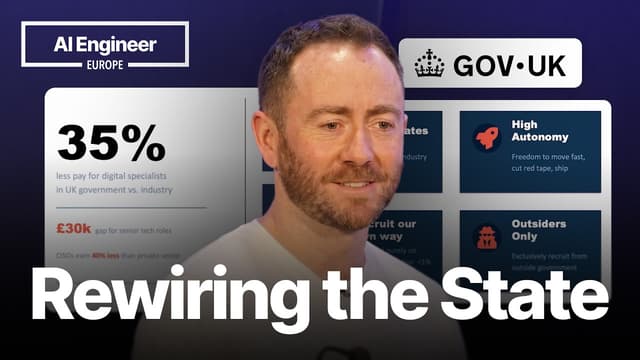
Eoin Mulgrew's AI Engineer Europe 2026 talk is a first-class primary source: a current-state disclosure — covering hiring, structure, and concrete outcomes — of the "government AI transformation program" the UK government's (No.10 Downing Street, the Prime Minister's Office) Data Science Team is currently running. Alongside the AI-industry movements MEMEX has accumulated to date — frontier labs at Anthropic / OpenAI / Google DeepMind, enterprise adoption cases (Intercom / PFF) — this adds a new layer as an important node: the AI adoption logic on the state-institutional side.
The starting point of the talk is the deep public-services crisis the UK is in. The NHS waiting list is 7.25 million people (roughly 11% of the UK population); the courts backlog is around 350,000 cases; only one in five planning applications is decided within the deadline. Behind this lies a productivity crisis in the public sector, and the Tony Blair Institute's estimate puts the annual productivity opportunity from government AI use at £40 billion (about ¥7.5 trillion, equivalent to one month of Japan's national budget). The talk is concrete proposals for how to close the gap between this enormous opportunity and the structural problem that government cannot recruit and develop technical talent.
What is 10DS — the Data Science Team at No.10
10 Downing Street Data Science Team (10DS), where Eoin sits, was set up during the COVID-19 pandemic. The core business is to "support the most important decisions of the state being made on the best evidence." Today, however, it is shifting toward not just driving AI adoption within No.10, but also rapidly accelerating AI adoption across strategically important government organizations.
Behind this shift is the recognition that the traditional civil service is structurally weak at recruiting and retaining technical talent. Beyond the obvious pay issue, factors combine — "strong hierarchy," "heavy bureaucratic procedures," "extremely slow pace," "accountability to the public" — and the workplace stops being attractive to "the impatient type of technologist who wants to leave a mark on the world." On the other hand, trying to move the oil tanker directly would take decades — hence the Insurgency Model was chosen.
The Insurgency Model — 6 differentiators
The operating model of 10DS, as Eoin organizes it, has six differentiators that let it move independently of the traditional civil service:
- Operates with a No.10 mandate — the authority to enter departments that are usually difficult to penetrate and move things
- Unusually high political backing — operating inside strong political will to "deliver concrete results with AI as a government"
- Market-rate pay — not Meta-grade, but within a range that breaks through the civil service fixed pay cap
- Unusually high autonomy — can opportunistically choose which challenges to take on
- Its own hiring process — standard civil service recruitment is not optimized for hiring technical talent; 10DS runs a laser-targeted, demanding selection for technical skill. 0.7–0.8% success rate — on par with Google / Meta hiring pass rates
- Outsiders only — "take fellows, but don't have them stay on in the civil service" — a structure that continuously injects fresh blood and spawns new teams inside government
This last "outsider hiring" is decisively important. Many of the technologists who come in as fellows go on, after their term, to launch a different team inside government — the "spawn effect." Three spawn cases were mentioned in the talk:
- AI Safety Institute (AISI) — the world's first frontier-model evaluation institution, a flagship for the UK to lead the international AI-safety conversation. Early fellow Dr. Harry Coppock led the cybersecurity workstream and later led the inspect tool An isolated environment developed by the AI Safety Institute that safely tests how an AI agent behaves when given autonomy and tools. It is becoming one of the international standards in frontier-model risk evaluation, frequently referenced in safety discussions like Anthropic Glasswing. In Eoin Mulgrew's talk, early fellow Dr. Harry Coppock leading the inspect tool was introduced as a symbolic success case of fellowship → government-institution spawn.
- Incubator for AI (i.AI) — spun out under DSIT (the Department for Science, Innovation and Technology); a team that incubates AI solutions across the public sector. Most of the founding technical team are former 10DS fellows
- Justice AI — a new team under the MoJ (Ministry of Justice); the founder is former fellow Dan James, embedding forward-deployed engineers in actual prisons
You can position this as a fourth model — an extension to national scale of Chris Lovejoy's (Notius Labs) Domain-Native AI Organization three-model framework (Oracle / Evaluator / Architect). The structure of "Insurgency = a small elite team propagating proof points from the center outward" goes beyond vertical-AI organizational theory and can be re-read as "an organizational change theory for state institutions."
Concrete outputs — 4 implementations inside No.10
Concrete outputs from the past few weeks, as disclosed by Eoin (some details withheld for classification reasons):
- Policy Simulation Tool — a tool that lets policy decisions like Universal Credit (the UK's integrated social-security benefit) be tested in real time against household impact. Policy teams can quantitatively compare multiple options before they decide. "Not replacing human analysis, but a state in which far more decisions are based on high-quality modeling"
- UK Statute Book analysis tool — an AI analysis of all UK legislation that the Cabinet Office was about to outsource to an external law firm for £1.5 million (about ¥280 million), replaced in two weeks by fellowship forward-deployed engineers working with in-house lawyers. Beyond cost savings, the analysis speed now keeps pace with the rate of legislative change — sustainably
- Delivery Red Teaming Tool — No.10 owns delivery responsibility across all major projects + manifesto commitments. For each delivery report from a department, decision-makers get a two-stage view: (a) an agent they can query for content, and (b) flags for the reporting team's past optimism bias / risk-rating tendencies / mitigation effectiveness
- First public-facing delivery dashboards — two dashboards letting citizens see directly "how the UK government is delivering" were released in two months. One is a progress dashboard for the AI Opportunities Action Plan The AI national strategy Action Plan that Matt Clifford drafted for the UK government roughly a year ago. Goals include compute infrastructure, AI adoption, and establishing the UK's AI leadership as a nation. 10DS published execution progress as a public dashboard in early 2026 — the first case of the government's AI implementation being made transparent to citizens. ; the second is a new public service launching in two weeks
The collaboration model — forward deployment across institutions
Complex challenges are addressed with a partnership model. 10DS sends forward-deployed engineers on long-term placements to other departments and institutions. Collaborations detailed in the talk:
Extract (DeepMind collaboration) — built by i.AI together with DeepMind, based on Gemini. A tool that digitizes a large portion of planning applications, including hand-drawn maps and handwritten documents. It directly attacks the talk's headline number (one in five planning applications decided in time). The UK Prime Minister announced it at London Tech Week, and it is now rolling out to all local authorities. A first step toward the vision in which "eventually AI decides planning applications automatically."
Justice AI — the team launched by former fellow Dan James. Forward-deployed engineers are embedded in actual prisons to use AI to (a) block drugs flowing into prisons, (b) make manual processes more efficient, and (c) improve prison security. The most symbolic fellow Eoin introduced was Will — a former Harvard dropout, a former YC founder (who sold his company) — and footage of him standing at the front gate of HMP Wandsworth prison holding its keys in his second week visualized 10DS's recruiting thesis: "we hand you the keys to the state."
AI for Education — frontier-model evaluation of AI tutors. Seventy teachers play the role of students in tests, with safeguards built and benchmarks set for things like cognitive load. The stage of pursuing both "safe conversation between children and AI tutors" and "access to world-class tutoring regardless of socio-economic background."
Editorial Observations — what state-institutional AI adoption means for the industry
Three lenses for covering this talk on MEMEX.
(1) The first case in which the logic of state-scale AI adoption is named. The Pentagon 7-contractor agreement (AI national procurement on the US side) and the geopolitical discussion in Anthropic's $350B valuation were procurement / investment-side conversations, but Eoin's Insurgency Model is the first systematic disclosure of what is happening inside state institutions as an operating theory. This becomes a foundational node on MEMEX's AI×politics axis — a reference point for future reporting related to the UK government.
(2) A state-scale extension of Chris Lovejoy's organizational-model theory. Chris's Oracle / Evaluator / Architect was organizational theory for vertical AI products; Eoin's Insurgency proposes a fourth model — "a meta-organization for transforming the organization itself." On the scale axis — enterprise (Intercom 1,400 people) → mid-sized business (PFF 200 people) → state (UK civil service 400,000 people) — organizational-change theory is being systematized.
(3) Divergence between US and UK national AI adoption strategy. The US runs the "giant procurement + direct contracts with large vendors" line symbolized by the Pentagon 7. The UK runs the "small elite teams radiating from the center" line of 10DS / AISI / i.AI / Justice AI. Even within the same project of national AI use, the implementation philosophy differs. The Q&A suggested loose information exchange with Singapore / US Digital Service / TechForce, but comparative research on international government AI-adoption patterns has only just begun. There is value in MEMEX continuing to track this divergence.
Video Outline
- (00:00) Self-introduction, 10 Downing Street Data Science Team (10DS)
- (01:54) The UK public-services crisis — 7.25 million on NHS waiting lists, 350,000 in the courts backlog, only one in five planning applications on time
- (02:40) Tony Blair Institute estimate — £40 billion (~¥7.5 trillion) annual productivity opportunity from government AI use
- (03:30) Why government is structurally weak at developing technical talent (pay / hierarchy / bureaucracy)
- (05:20) Proposing the Insurgency Model — set up a shackles-off small unit at the center
- (05:50) The 6 differentiators (mandate / political backing / pay / autonomy / hiring / outsiders only)
- (07:43) Hiring results — from labs / big tech / YC founders / serial entrepreneurs
- (08:30) "Missionaries not mercenaries" — economic viability + purpose, both
- (09:00) Operations — handle low-hanging fruit in-house, complex challenges via partnership
- (10:00) Case 1: Policy Simulation Tool (Universal Credit)
- (11:00) Case 2: UK Statute Book analysis (£1.5 million → replaced in 2 weeks)
- (12:30) Case 3: Delivery Red Teaming Tool + optimism-bias detection
- (13:50) Case 4: first public-facing delivery dashboards — two published
- (15:00) Collaboration 1: AI Safety Institute (Harry Coppock + inspect tool)
- (15:35) Collaboration 2: Incubator for AI (i.AI), Extract (DeepMind collaboration, planning apps)
- (17:30) Collaboration 3: AI for Education (frontier-model evaluation + safeguards)
- (18:30) Collaboration 4: Justice AI, forward-deployed engineers in prisons (the Will case)
- (20:00) Scale challenge — what a small elite team can do, the shift to horizontal work
- (21:00) Q&A 1: policy sycophancy risk (red-teaming + user upskilling)
- (22:30) Q&A 2: scale strategy (from central hacks to redesigning the whole bureaucracy)
- (25:30) Q&A 3: the student-motivation problem with AI tutors
- (27:00) Q&A 4: international collaboration (Singapore / US Digital Service / TechForce)