Barry Zhang · 03:07 "In other words, they're folders."
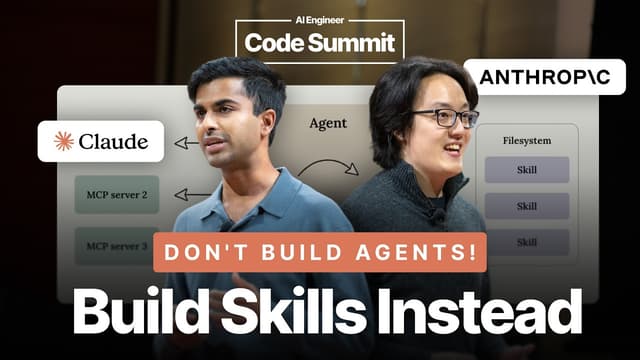
Over the past year, the scaffolding around AI agents has rapidly standardized. MCP has become the de facto for agent connectivity, Claude Code went GA, and the Claude Agent SDK lets you ship production-quality agents out of the box. But — agents have gotten smarter, and lack domain expertise. So Anthropic announced Agent Skills in October 2025 and declared: "we've stopped building agents and started building Skills."
Two speakers. Barry Zhang — Anthropic research engineer, co-author of "Building Effective Agents" (December 2024), widely referenced in the industry. The other is Mahesh Murag — Anthropic Member of Technical Staff, lead author of MCP. Both, while building their own prototypes, arrived at the shared recognition that "code isn't just one use case — it's a universal interface to the digital world."
Skills are simple in form — one folder. Inside sit a Markdown-format `skill.md` (description + main procedures) and the scripts and files that serve as tools. Version it in Git, or drop it into Google Drive, or send it as a zip — whatever works. The largest design goal: "anyone with a computer — human or agent — can create one." In the five weeks since the announcement, thousands of Skills have been created, and Fortune 100 companies are starting to adopt them as a way to teach Claude their internal best practices.
The design key is "progressive disclosure." At execution time, the model sees only the metadata declaring the Skill's existence. When needed, it reads the body of `skill.md`; if needed further, it invokes files and scripts inside the folder. Even with hundreds of Skills, the context window is not eaten through. Anthropic positions this mechanism as "a bridge until true continual learning arrives."
Key Observations
The extreme simplification "Skills are just folders" (03:07)
Not an elaborate DSL, not a proprietary format. Just a folder + Markdown + scripts. "We've used files as a primitive for decades, we like it, so why change it now?" — that is the response. The result is that non-technical people (finance, HR, accounting, legal) have begun building their own Skills, as the talk demonstrates. The shift: from "running an agent is the job of an AI researcher" to "an on-the-ground specialist packs their knowledge into a folder and hands it over."
The contrast "I wouldn't ask Mahesh to file my taxes" (02:24)
Barry's tongue-in-cheek setup. Mahesh, the IQ-300 math genius vs Barry, the seasoned tax specialist — who do you ask about taxes? Answer: Barry. Today's agents are like Mahesh — intelligence is there, but domain expertise is missing. You don't want to ask it to reconstruct the 2025 tax code from first principles. Skills are the mechanism for handing over "the procedural knowledge of a specialist." The joke doubles as an in-team running gag and is a smart way to keep the tone of the talk light.
"MCP provides connectivity, Skills provide expertise" (08:24)
Mahesh, the lead author of MCP, explicitly delineates MCP and Skills. MCP is the standard for connecting to external tools and data; Skills are the package of expertise that sits on top. He notes that more and more Skills bundle multiple MCP tools into a single workflow. He closes with the industry analogy "model = processor, agent runtime = OS, Skills = apps" (12:32). "A few companies build the processor and the OS, but the real value comes from the millions of apps" — positioning the Skills layer as an open layer anyone can build for.
Video Outline
- (00:00) Self-introductions, what changed in the year since the previous talk (MCP / Claude Code / Agent SDK)
- (01:14) The recognition "all we need is code" — Claude Code is in fact a general-purpose agent
- (02:08) The wall of domain expertise — being smart is not enough
- (02:34) The Mahesh vs Barry tax-filing joke
- (03:00) What Skills are — one folder, a set of Markdown and scripts
- (03:30) Why files were chosen as the primitive — ease of sharing and portability
- (04:00) Examples of embedding scripts as tools — self-documenting, not loaded until needed
- (04:21) Progressive disclosure — the three stages: metadata → skill.md → folder body
- (05:08) The ecosystem has grown rapidly in five weeks — three kinds of Skills
- (05:50) Foundation Skills — generating Office documents, Cadence scientific research
- (06:38) Third-party Skills — BrowserBase's Stagehand, Notion workspace integration
- (07:25) Enterprise Skills — Fortune 100 internal best practices, dev-productivity teams
- (08:24) Complementary relationship with MCP — connectivity + expertise
- (09:05) The new architecture of general-purpose agents — agent loop + runtime + MCP + Skills
- (10:33) Open challenges — testing / evaluation, version management, dependency management
- (12:02) The real value of Skills is sharing and distribution — the vision of collective evolution of organizational knowledge bases
- (13:23) Concrete steps toward continual learning — Claude itself creating Skills
- (14:32) The analogy with the history of computers — model / runtime / Skills = processor / OS / apps
- (15:38) Conclusion — stop building agents, start building Skills
Sources
Don't Build Agents, Build Skills Instead — Barry Zhang & Mahesh Murag, Anthropic (AI Engineer)