Samuel Humeau · 08:21 "Prehistory was stitching together spoken words, like SNCF (French National Railways)."
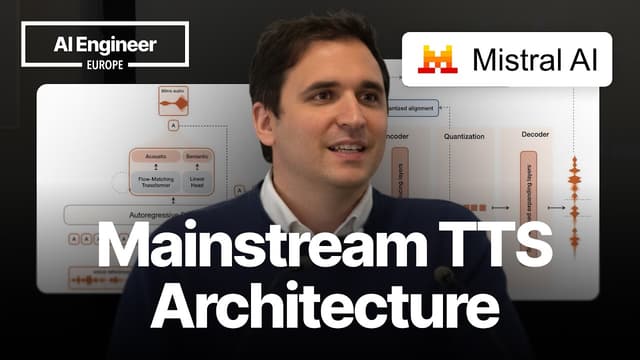
A 22-minute talk centered on the observation that TTS (Text-to-Speech) architecture has, over the past few years, converged toward a design that "looks like an LLM." From the concatenative TTS of station announcements (SNCF stitching recorded words together) → the neural generation that produces each sample in sequence → the generation of the whole at once → and now, the autoregressive decoder backbone (the LLM pattern) toward which most research labs are converging — Samuel walks through this technical history while demonstrating Mistral's Voxtral TTS, released a month earlier.
The speaker is Samuel Humeau — an AI researcher at Mistral AI. After an ML master's at EPFL (École Polytechnique Fédérale de Lausanne, Switzerland) → Diffbot → research engineer at Facebook AI Research (FAIR), where he worked on ParlAI's bi-encoder / cross-encoder, he moved to Mistral. He is one of the co-authors of the paper on Voxtral TTS (4B parameters, 9-language open-weight TTS, 62.8% human-evaluation preference against ElevenLabs Flash v2.5) announced in March 2026. In the talk he discusses the model's architecture in public.
The core of the discussion is bitrate. Text contains only about 15 bits of information per second; standard-quality MP3 audio is 200,000 bits per second — orders of magnitude more. So treating audio LLM-style requires compressing it into a sequence of tokens. In Mistral's case, audio is cut every 80 ms, each frame is converted into 37 tokens — about 500 tokens per second. "A codec (encoder + decoder) that converts audio into a token sequence usable like an LLM's vocabulary, while preserving both semantic information and acoustic features" — this is the common industry base.
Mistral departs from this base in one point. While many labs place a small autoregressive model after the backbone (the large autoregressive model) to generate the 37 tokens in sequence, Voxtral TTS generates the 37 tokens at once with a diffusion model. He introduces it as "a cool use case for flow matching models (a diffusion variant)." A design that achieves low latency — "17 ms from text input to the first playable audio packet" — on a single GPU.
Key Observations
"My speech carries only 15 bits per second" — the self-deprecating frame (11:04)
A small joke in the talk. "I'm very competitive and also a very good speaker, but the actual information is only 15 bits per second — try to do better than that." It looks like a joke, but the contrast that follows — "compared with audio at 200,000 bits per second, 15 bits per second of text is not much" — leads directly to the core question of the talk: "Why treat TTS as a token sequence rather than as full audio?" An elegant introduction that uses self-deprecation as the doorway into a technical argument.
Declaring that the "prehistory" of voice generation is SNCF (08:21)
He lays out the technical history in four stages: "Prehistory = concatenative TTS = stitching recorded words together like an SNCF station announcement" → "Neural generation = generating one sample after the next" → "Generating the whole at once" → "Modern = tokenize + LLM-style backbone." Having "SNCF" as a concrete anchor turns an abstract architectural history into a picture instantly. The flourish of dismissing as "prehistory" the kind of voice — "La gare de … Paris … Nord" — you hear at stations as words spliced together is also Sam's French-inflected self-mockery.
Voxtral TTS's differentiator = 37 tokens generated at once via diffusion (15:30)
Sam repeatedly says "most people (= most of the industry)," but Mistral departs from that majority in exactly one place. Many labs place a "small autoregressive model" after the backbone (the large autoregressive model) to produce the 37 tokens of a frame one at a time. Voxtral TTS instead uses a diffusion model to emit all 37 tokens at once. Introduced as "a cool use case for flow matching (a diffusion variant)." Architecturally, this is also the lineage of Imagen / Stable Diffusion entering the audio side. The "we won't go too deep in today's video — read the technical report" note actually serves as the hook for those who want to dig in.
"You can get very far just by using voice as an interface" (20:01) — the cascade defense
Sam's response to a Q&A question: "Big labs like Google are pushing native speech-to-speech, but Mistral leans toward the cascade architecture (STT → LLM → TTS). What do you think?" Sam: "The central LLM is very capable and handles many tasks. So the interface-side advantage is that you can use the same interface for every kind of agent. Streaming the text tokens the LLM outputs and turning them into voice — that design alone gets you very far." A nicely positioned counter to Neil Zeghidour (Gradium), who argued at the same venue just before that "you can't reach the 'Her moment' with a cascade."
Video Outline
- (00:00) Self-introduction (Mistral and former FAIR)
- (01:14) Mistral company introduction — frontier lab, B2B, AI transformation support
- (01:46) TTS use cases — from offline (reading articles aloud) to agent interfaces
- (02:30) The voice agent pipeline — STT → LLM → TTS, latency as the key constraint
- (03:30) Introducing the vibe-coded demo app
- (03:44) Cloning Paul's voice with Voxtral TTS, reading a poem aloud
- (04:55) Conference assistant — answering session info in Paul's voice + Voxtral
- (06:24) Multilingual support — generating French with an English speaker's voice (preserving the accent)
- (06:54) Cloning his own voice: "Hello, this is Sam"
- (07:27) The era in which voice identity becomes part of a brand (= as much as a website's look)
- (08:01) The history of voice generation — concatenative (SNCF-style) → neural generation
- (08:55) Industry convergence — autoregressive decoder backbone (the LLM pattern)
- (10:00) The role of the codec (encoder + decoder) — 80 ms frames → tokenization
- (11:04) "My speech is 15 bits/sec" — text vs audio bitrate contrast
- (11:50) Mistral's approach — 80 ms × 12 fps × 37 tokens = 500 tokens/sec
- (13:48) Backbone + small model (the common industry pattern)
- (14:21) Mistral's differentiator — diffusion generates 37 tokens at once
- (15:00) Conditioning strategy variations (the text-to-audio bridge)
- (15:49) Mistral picks text-first (provide the full context up front)
- (16:13) Latency — 17 ms (text → first audio packet, single GPU)
- (16:30) Next steps — real-time text streaming (interleaving / dual-stream)
- (17:34) Q&A — joint text/audio generation in voice agents?
- (18:25) Q&A — are the voice-cloning weights public? (The encoder part is not)
- (19:25) Q&A — native S2S vs cascade, which is right?
- (20:43) Q&A — interleaving next, or a different approach
Sources
Why TTS Models Now Look Like LLMs — Samuel Humeau, Mistral AI (AI Engineer)