Marlene Mhangami · 03:10 "Clean code bases amplify AI gains; unchecked AI in a code base amplifies entropy. In a 14x commit surge, this is what separates winners and losers."
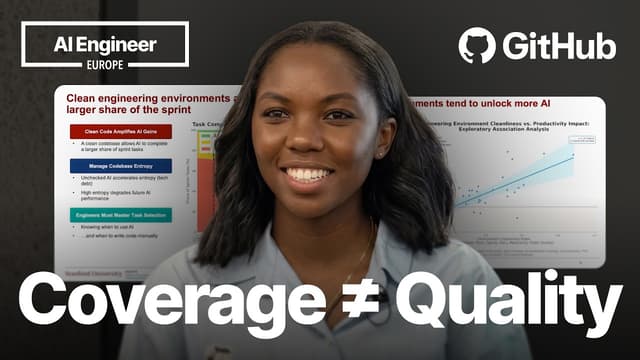
Marlene Mhangami's AI Engineer Europe 2026 talk addresses test design that prevents "the volume of writing simply ballooning" within the 14x commit surge (14 billion commits projected this year) that GitHub is observing in 2026. Starting point: Stanford's 120,000-developer study — an inconvenient truth that AI productivity gains scale with the cleanliness of the code base, and that unchecked AI introduction accelerates entropy. The technique at the core of this talk is one that proactively avoids the failure mode "PR counts grow, refactor time eats it all, net improvement of 1%."
From the MEMEX editorial perspective, what matters is that this is a complementary axis to Laurie Voss's (Arize) "Ship Real Agents" idea that "evals are tests for the AI engineer" — showing how to implement that on the non-AI-product side (an ordinary web app). Voss is about evals for AI products; Marlene is about evals for AI-generated code — both are about "how to guarantee quality after AI has run."
"TDD died in 2014, but it comes back in the AI era"
Marlene's historical recap: in 2014, Rails creator DHH declared "TDD is dead" on his blog. The whole industry became aware of the harms of excessive unit-test-centric thinking. Main critiques:
- Testing implementation details — renaming a method breaks the test, even though functionality is unchanged
- Self-affirming tests — when AI generates tests, it tends to write tests that pass, not tests that verify behavior
- Code coverage worship — 100% coverage still breaks in production
The solution: behavior-driven TDD, as proposed by Ian Cooper — test stable contracts (APIs, exported modules) and final behavior (price-calculation results), and write tests that don't break on internal refactors. The same line of thinking as Pedro Rodrigues's (Supabase) three principles of skill design, "encode the opinionated workflow into the skill" — anchor at the most stable layer, behavior.
The time allocation of red-green-refactor reverses
The new shape of TDD in the AI era:
- Red (write the failing test) — humans used to take time; in the AI era, seconds
- Green (write code that passes the test) — used to be hours; in the AI era, minutes
- Refactor (improve quality) — this is where human time concentrates
This is Marlene's core thesis. The step in which "humans review AI-written code and tidy architecture and readability" becomes the developer's greatest value-add. It aligns cleanly with Karpathy's Software 3.0 / Agentic Engineering claim that "the abstraction layer moves up one level."
Playwright + MCP — the weapon for measuring behavior
Microsoft's Playwright was originally an end-to-end testing framework (with Python / TypeScript / C# bindings). Three integration paths matured in 2025–2026:
- Playwright MCP server — agents drive the browser directly
- Playwright CLI — integrates with existing setups
- Playwright Agents — install planner / generator / healer as three agents via the `agent.md` file
Demo: adding "search bar + sidebar filter" to Tailspin Toys (a fictional toy e-commerce site). Marlene drives it from the GitHub Copilot CLI:
- The WorkIQ skill pulls a feature-request email from Outlook into the CLI
- Instruction: "proceed with red-green TDD — write a failing Playwright test first"
- The agent analyzes the codebase and generates a Playwright test (search-field placeholder lookup, input, filter-button click, etc.)
- Run the test (in browser headed mode with screenshot recording), confirm failure
- Generate the feature code and pass the test
- Once passing, Marlene spends time in the refactor phase
What matters here is that "the test looks at behavior" — "search 'Furby' and the Furby results display," "filter a specific price band and only the matching toys remain" — the user's view. Not implementation details. That way, even if AI rewrites the internals during refactor, the test doesn't break, and behavior guarantees persist.
Best practices — four field tips
Marlene's closing practical tips:
- Attach Playwright screenshots to the PR — reviewers can see how the feature actually looks; explainability of black-box AI code improves
- Run headless mode in CI — run tests without browser display, set them on GitHub Actions / Azure Pipelines continuously
- Commit before agent edits — commit to git before AI makes large changes, guaranteeing rollback on failure
- One feature, one test — narrow to one test per feature, so the agent doesn't get confused
Asked about state management in complex admin panels, Marlene answers: "Use Playwright Agents' `agent.md` — specialized instructions for state are built in." If needed, combine with direct API tests. A hybrid strategy: Playwright is browser-based; backend APIs test on a separate layer.
Editorial Observation — How to handle "14x commit volume"
Three angles MEMEX takes on this talk.
(1) The strategic meaning of GitHub Octoverse data. 1B commits in 2025 → 14B projected in 2026 = 14x. This is the one piece of hard data that shows the production rate of the software industry as a whole shifted by an order of magnitude in a year. In the same period, Intercom reached 2x throughput in 9 months and PFF reached 25x deploys / 10x output in 2 months. Individual company numbers line up with industry-wide commit volume — evidence of structural change.
(2) The "quality vs. speed" dichotomy dissolves. Marlene's citation of the Stanford study — "clean code base + AI = large productivity gain, unchecked AI = entropy" — is the most important fork in development organizations of 2026. Organizations that just chase PR counts capture only 1% of AI's benefit; organizations that invest in test infrastructure capture a 10–25x gap.
(3) A core piece of Microsoft / GitHub's platform strategy. The combination of Playwright + Copilot CLI + WorkIQ (M365 integration) shows that GitHub is completing its transformation from "mere code host" to "AI-native development platform." It runs in parallel with Microsoft × Anthropic integration (Claude on Azure) at the $350B Anthropic valuation structure, while AI integration advances on the GitHub side as well.
Video Outline
- (00:00) Introduction, Microsoft & GitHub Core AI division
- (01:00) GitHub Octoverse 2025 — 1B commits per year, 14B projected for 2026
- (02:10) Core conclusion of Stanford's 120k developer study
- (03:30) History of TDD — "dead" in 2014, Simon Willison's red-green revival
- (04:30) The trap of excessive code coverage (implementation detail, self-affirming)
- (06:00) Behavior-first TDD solution — anchor on stable contract
- (07:00) Playwright introduction, multilingual support
- (08:00) Reversal of red-green-refactor time allocation
- (09:00) Three-way integration of Playwright MCP / CLI / Agents
- (10:30) Tailspin Toys demo begins — pulling the request in with WorkIQ
- (13:00) Failing test generation, execution, feature implementation, passing
- (16:00) Four best practices
- (17:30) Q&A — state management with Playwright Agents, mobile / desktop support