Dario Amodei · WSJ 04:30 "Software is going to become cheap — maybe almost free. The assumption that you have to amortize what you build across millions of users may start to be false."
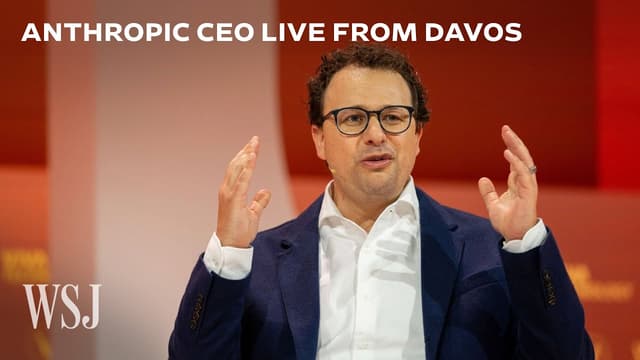
On January 20, 2026, Dario Amodei (co-founder and CEO of Anthropic) sat for a 32-minute live interview with Emma Tucker (WSJ editor-in-chief) at WSJ Journal House at Davos 2026. The same week, on the WEF main stage, he joined Demis Hassabis (CEO of Google DeepMind) for "The Day After AGI," moderated by Zanny Minton Beddoes (editor-in-chief of The Economist) for 31 minutes. About five weeks later, in late February, immediately after Defense Secretary Pete Hegseth designated Anthropic a Supply Chain Risk designation A regulatory measure the U.S. Department of Defense typically applies to suppliers tied to foreign adversaries, effectively prohibiting military contractors from doing business with the designated supplier. Historically applied to entities like Kaspersky Labs (Russia) and Chinese chip companies. In February 2026, Pete Hegseth applied it for the first time to a U.S. company, Anthropic. Dario described it as 'an unprecedented intervention in the private economy.' Anthropic has signaled it will challenge the legal basis and scope in court. — an unprecedented step — Dario sat for a 28-minute emergency exclusive with CBS News's Jo Ling Kent.
Read in sequence, the three pieces show how the " optimism + regulation thesis The frame Dario Amodei has put forward consistently since his 2024 essay 'Machines of Loving Grace.' He is radically optimistic about AI's positive impact (cancer treatment, eradicating tropical disease, economic growth), while arguing that governments and society must take seriously the risks of economic inequality, misuse, autocratic abuse, and loss of control. The stance: 'not a doomer, but the concerns are real.' Dario articulated at Davos operationally tested itself against the Pentagon clash. The Davos arguments were abstract policy proposals; five weeks later he found himself embodying them, with Anthropic put to the test on whether it could actually hold its own red lines. This piece does not annotate the three independently — it follows how the logic of Dario's claims functioned under real-world pressure.
A note on how this material came to attention. Rohan Paul ( Rohan Paul X user @rohanpaul_ai. A figure known for short-edit clips of important AI industry interviews. Re-clips WSJ / Bloomberg / podcast segments and circulates them with concise framing. MEMEX, as of May 2026, has registered him as a trusted source on the quality of his selection — 'honest.' ) cited a WSJ clip on X (the "software is going to be cheap, maybe almost free" line) → editorial judgment was to obtain and read all three primary sources in full. The line Rohan selected is genuinely one of the central messages of the WSJ video, but the originals contain other claims of equal or greater importance (the unprecedented combination of high GDP growth × high unemployment, the scientist-led vs. entrepreneur-led AI company dichotomy, the Anthropic Economic Index). Rohan's editorial choice to compress to one clip on X, and MEMEX's choice to preserve all three pieces as primary source, are two different forms of editorial work.
Part 1 — Davos WSJ: the economics of software becoming free
Emma Tucker opens with a big-picture question: "Last year at this time, everyone was excited about what AI could do. This year the conversation has shifted to what AI is going to do to the world." Dario gives a quick "No (governments and companies are not adequately prepared)" and then launches into a long answer (00:54).
The economics section drew the most attention. Dario describes the current state of AI as " Moore's Law for Intelligence A formulation Dario Amodei has advanced since 2025: the hardware Moore's Law applied to AI. The cognitive capability of models continues to improve exponentially on the order of months. At the WSJ interview, Dario said 'the actual trajectory of the field has been surprisingly on the same trajectory' — independent of the media's swings between excitement and disappointment, the underlying technical progress has continued on a smooth exponential. ." Over 15 years of observing the field, "the media and public opinion oscillate every 3–6 months between 'excited' and 'it's over,' but the technology itself has been smooth exponential" (02:35). Then he gets to the main point:
"My view is that the signature of this technology will take us into a world with very high GDP growth and simultaneously very high unemployment and inequality. Historically this is an almost unprecedented combination. The assumption that high GDP growth = lots of jobs may not hold for a technology this disruptive. 5–10% GDP growth with 10% unemployment isn't logically contradictory, but it has never happened in history" (04:00–04:30).
As a concrete example, he points to Claude Opus 4.5. "Inside Anthropic there are several engineering leads who say, 'I'm no longer writing code — I just have Opus write it and I edit.'" Then the title quote arrives:
"Software is going to become cheap — maybe almost free. The assumption that you have to amortize the software you build across millions of users may start to be false. For example, you might write an app for this conference for a few cents and say, 'let's all talk to each other'" (04:30–05:30)
This corresponds exactly to the economic version of Software 3.0 that Andrej Karpathy laid out at Sequoia AI Ascent 2026. Where Karpathy used the Menugen app example to argue "apps lose their reason to exist as neural-net capability improves," Dario rephrases the same paradigm from the Anthropic CEO's seat: "the premise of software's amortization model is about to become false." In January 2026 (Davos) and May 2026 (AI Ascent), two industry leaders in different settings independently advance the same structural claim — an important convergence as the industry's point of arrival.
Enterprise vs. consumer as a strategic choice — "it's easier to pick a model that doesn't fight your business incentives"
Emma Tucker presses: "I've heard Anthropic was founded because OpenAI wasn't taking safety seriously — has competitive pressure softened that stance?" (11:11). Dario's response is the core:
"We took a different route from the other players. One of the early decisions that turned out well was making Anthropic enterprise-centric rather than consumer-centric. It is very hard to fight your own business incentives. It is easier to pick a business model that doesn't require you to fight them. With consumer AI there are concerns — you need to maximize engagement, slop emerges, you move toward advertising. Anthropic doesn't have to operate that way. We sell to businesses, and what we sell has direct value. We don't need to monetize a billion free users" (11:30–12:30)
This describes Anthropic's organizational philosophy in one paragraph. Not "choose safety," but a structural design that "chooses a business model that doesn't allow you to deviate from safety." Five weeks later, in the Pentagon clash, it carries significant weight — because Anthropic is B2B-centric, the CEO can publicly state that "we can survive losing a single Pentagon contract" thanks to its business structure (detailed in Part 3).
Scientist-led vs. entrepreneur-led AI companies — a dichotomy
Another particularly striking frame from this WSJ session. Emma seems to have caught on to it during prep and asks for concrete examples. Dario's framing:
"AI technology is the combination of decades of research from academia and the past 10–15 years of scale from internet / SNS companies. As a result, some AI companies are led by people from a scientific background (myself, Demis), and others by entrepreneurs from the SNS generation. The difference is large. Scientist-led AI companies One side of the dichotomy Dario Amodei presented at the Davos 2026 WSJ interview. He cited himself and Demis Hassabis as examples. Scientist-background founders, in his framing, have a long tradition of considering the impact of the technology they build, do not duck responsibility, and were originally motivated by 'creating something new in the world' — which makes them worry when things might go wrong. The opposing 'entrepreneur-led' category refers to SNS-generation entrepreneurs, where 'engagement built through manipulating consumers' creates a different attitude through selection effects. have a tradition of thinking about the impact of the technology they build. They don't duck responsibility. Their initial motivation is 'creating something for the world,' so they worry when it could go badly. On the other side, the motivations and selection effects of the SNS-generation entrepreneur are different — they've been engaged in ways that involve manipulating consumers" (22:40–24:00)
This dichotomy connects to existing MEMEX coverage — Karpathy, the Project Glasswing announcement, Amanda Askell's philosophy dissertation. Dario, Demis, and Anthropic's philosopher leading Personality Alignment (Amanda Askell) all sit on the "motivated first by creating something for the world" side. OpenAI's Sam Altman, xAI's Elon Musk, and Meta's Mark Zuckerberg fall on the other side. Dario doesn't name the companies; the context is unmistakable.
Part 2 — WEF: Demis × Dario, "The Day After AGI"
Held the same Davos week, on the WEF main stage. Zanny Minton Beddoes (editor-in-chief of The Economist) moderates a 31-minute panel with Demis Hassabis (CEO of Google DeepMind) and Dario Amodei. Zanny notes at the top that "this is a bit like moderating a conversation between the Beatles and the Rolling Stones" — a rare dual-headed conversation on AGI.
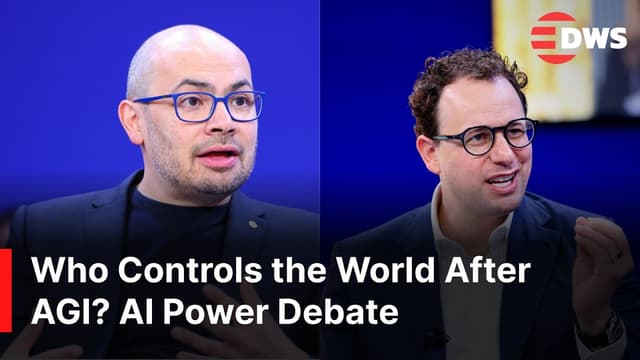
AGI timeline — 2026–2027 (Dario) vs. 5–10 years (Demis)
Zanny's first question: "Last year in Paris, Dario said a model that could do everything a Nobel laureate does across many fields would arrive in 2026–2027. It's 2026 now — has that prediction changed?" (01:09).
Dario confirms: "Always hard to know exactly when, but it won't be that far off." The mechanism is the Self-Improvement Loop A closed-loop concept discussed in AI development. 'Build an AI model that can write code → use it to accelerate AI research → speed up development of the next-generation model' — a recursive loop. Once it closes, model performance accelerates beyond what's possible with human intervention. Dario predicted at WEF Davos 2026 that 'in 6–12 months, models will be doing most / all of SWE tasks end-to-end.' On the same panel, Demis was cautious: 'whether it closes is really uncertain — AI can't accelerate the hardware portion.' : "build a model that can write code and do AI research, then use it to build the next generation and increase the speed." Inside Anthropic, there are already engineers who "no longer write code — they have Opus write it and they edit." "In 6–12 months, we may be at the point where the model does most or all of what SWE does end-to-end" (01:30–02:30).
Demis is more cautious. "I'm on the same timeline, but in some domains (coding, math), outputs are verifiable and easier to automate. The natural sciences are different — making chemical compounds or predicting physics requires experimental verification, and that takes time" (03:00–03:35). He adds: "There are Missing Ingredients A formulation Demis Hassabis presented at WEF Davos 2026: capabilities still missing on the road to AGI. Ability to solve existing problems is improving rapidly, but 'the ability to come up with the question in the first place / formulate new hypotheses / higher-order scientific creativity' is still lacking. He proposes alternative paths — world models, continual learning — that don't depend on Dario's self-improvement loop. . Beyond solving existing predictions or problems, the ability to come up with the question, to formulate hypotheses — that's the highest level of scientific creativity, and it's still missing" (03:25–03:55).
Zanny brings up a lower-level comparison. "At the time of the DeepSeek shock, Google DeepMind was seen as behind OpenAI; now it's the reverse. OpenAI has declared code red" (04:21). Demis responds modestly: "I was convinced from the start — Google DeepMind has had the deepest and broadest research bench" (04:48–05:00).
Dario's response is also interesting. "It's been a good year for both companies. The common thread is that both are research-led companies — focused on the model, trying to solve important problems" (10:25–10:50). Here the WSJ "scientist-led vs. entrepreneur-led" dichotomy reappears at WEF, explicitly placing Demis on the same side.
Labor markets — "half of entry-level white-collar jobs may disappear in 1–5 years"
Zanny brings real-world data: "Looking at labor market data over the past year, unemployment shows post-pandemic adjustment from over-hiring — you can't say AI is the cause" (13:55). Demis offers near-term optimism: " Lump of Labor Fallacy A well-known fallacy in economics: the intuitive but mistaken claim that 'the total amount of labor is fixed, so new technology that takes jobs leaves people fighting over what remains.' Empirically, new technology creates new job categories, and total employment isn't lost (historically: agricultural automation → factories → knowledge work). Demis at WEF presents this as near-term optimism — 'this is what happens in the short run' — while Dario expresses concern that 'this time, the exponential may be too fast for adaptation to keep up.' — what happens when a typical breakthrough technology arrives. Some jobs get disrupted, more valuable new jobs are created." But he adds: "This year, impact may begin to show up in junior / entry-level / internships. Google DeepMind itself is feeling the slowdown in junior hiring" (14:25–14:55).
Dario goes further. "Same as six months ago — I still think half of entry-level white-collar jobs could disappear in 1–5 years. Inside Anthropic, we're starting to see that we don't need to add headcount in junior / intermediate roles" (16:25–16:55). And: "The timeline gap between Demis and me ultimately comes down to a different bet on how fast the self-improvement loop closes" (17:30).
Dario follows with three economic-adaptation steps:
- Measure with the Anthropic Economic Index (which industries, which states / countries are AI spreading in)
- Support people's adaptation (including shifts from knowledge work to physical-world work)
- The government's role in income distribution — "the pie itself expands enormously. The question is distribution. Worry less about disincentivizing growth and more about whether growth reaches everyone" (09:00–09:30)
The last claim ("worry less about growth disincentives, more about distribution") suggests a 180-degree turn from mainstream economic policy thinking of the past 40 years. Dario says explicitly: "this is the opposite of mainstream opinion today, but as the technical reality changes, the thinking changes too."
Fermi paradox discussion — "humanity has already passed the great filter"
An audience question from Philip (co-founder of StarCloud): "The strongest case for doomerism is the Fermi Paradox A cosmological paradox formulated by physicist Enrico Fermi in 1950. Estimates suggest tens of billions of Earth-like planets in the galaxy, with civilizations that should be millions of years ahead of us, and yet we find no evidence of intelligent life anywhere. One explanation: 'advanced civilizations self-destruct (the great filter),' which AI doomers sometimes invoke. — there's no intelligent life visible in the galaxy" (28:36). Demis answers immediately:
"That can't be the explanation for the Fermi Paradox. If civilizations had self-destructed because of AI doom, we'd see paperclip maximizers or Dyson spheres across the galaxy. We don't see anything. The answer is something else. My prediction is that humanity has already passed the great filter — probably multicellular life was the filter. What happens next isn't guaranteed. We humanity will write it ourselves" (28:50–29:25)
Demis's framing is one of the sharpest scientific rebuttals to industry doomer discussions: "we are a rare being that has already passed a brutal evolutionary gate — the next several decades are ours to write." A strong statement of agency. The most memorable moment in the 31-minute WEF panel.
Part 3 — CBS News Exclusive: the Pentagon clash
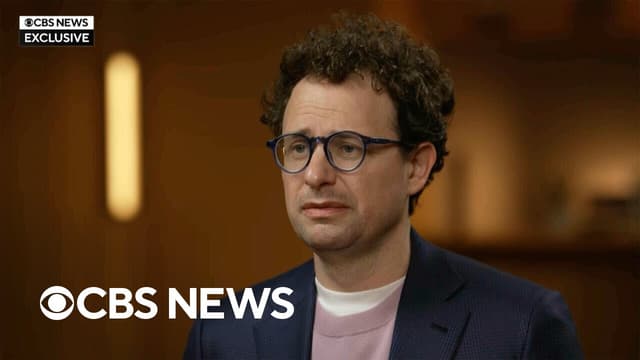
About five weeks after Davos, on a Friday in late February 2026 — hours after Defense Secretary Pete Hegseth tweeted that Anthropic was being designated a "supply chain risk" — Dario sat for an emergency exclusive interview with CBS News's Jo Ling Kent. Over 28 minutes, they discussed Anthropic's red lines, the timeline of the Pentagon clash, and the response to Trump.
Anthropic's two red lines
Jo Ling Kent leads with: "Why are you refusing unrestricted provision to the U.S. government?" (00:08). Dario opens by setting the context:
"Anthropic has actually been the most lean-forward of all AI companies in working with the U.S. government and military. We were the first to put models on the classified cloud, the first to build custom models for national security, and we are already deployed across the intelligence community and the military — for cyber and combat support operations. Because we want to defend this country. Because we want to defend the U.S. against autocratic adversaries like China and Russia" (00:18–00:55).
But he continues: "There are Red Lines (Anthropic) Two absolute conditions Anthropic has held since the start of its Pentagon negotiations in early 2026: (1) domestic mass surveillance — using AI to mass-surveil U.S. citizens domestically; (2) fully autonomous weapons — weapons that fire without human involvement. Dario emphasized that '98–99% of use cases are fine, only the remaining 1% is in scope.' In February 2026, when the Pentagon refused to budge on these two conditions, the result was the unprecedented supply chain risk designation. Dario characterized it as 'an unprecedented intervention in the private economy' and 'retaliatory and punitive,' and signaled a court challenge. . 98–99% of use cases are OK, but we have concerns about the remaining 1%":
- Domestic mass surveillance: "Things like the government buying data collected by private companies en masse and analyzing it with AI. Technically legal, but pre-AI it was practically impossible. The technology has outrun the law" (01:30–01:55)
- Fully autonomous weapons: "Different from the partially autonomous ones used in Ukraine. Weapons that fire without human involvement. Modern AI systems are nowhere near the reliability level required for fully autonomous weapons. And there's an accountability problem — in a system where one person coordinates 100,000 drones, who holds the button, who can say no" (02:00–03:00, returned to at 26:30)
The Pentagon negotiations and the "retaliatory and punitive" assessment
Jo Ling Kent confirms: "I'm told the Pentagon agreed in principle to these two constraints. Why didn't the deal close?" (03:13). Dario's response:
"The Pentagon issued a three-day ultimatum: 'agree to our terms in three days, or face supply chain risk designation or the Defense Production Act.' At one point they sent over language saying they'd meet the conditions, but it was riddled with escape clauses — 'where the Pentagon deems appropriate,' 'to the extent permitted by law' — with effectively zero concessions. We wanted a deal from the beginning" (03:35–04:30).
Dario's sharpest choice of words comes in his response to Trump's tweet ("Anthropic's selfishness is endangering U.S. service members"):
"Our position is clear. We have two red lines. We've had them from day one. We're still defending those red lines. We won't move on them. (...) Disagreeing with the government is the most American thing in the world. We are patriots — everything we do is for this country" (22:50–24:30)
This is the editorial axis of the piece: five weeks after Davos, where Dario said "scientist-led AI companies have a tradition of thinking about the impact of the technology they build, and don't duck responsibility," he found himself testing that same philosophy against the strongest possible opponent — the Pentagon. And he didn't move his red line.
"We survive" — the B2B-centric business structure under pressure
Jo Ling Kent's late-stage question: "Can Anthropic survive as a business?" (28:14). Dario:
"Not just survive — we're fine. The impact of this designation is limited. The Hegseth tweet was framed to suggest private military contractors can't use Anthropic at all, but legally that isn't true. It only means private contractors can't use Anthropic as part of military contracts. Far more limited impact" (28:35–29:20).
Here the enterprise-vs.-consumer argument from the Davos WSJ piece comes into effect. If Anthropic had been consumer-centric, "fear of losing a billion users" might have pushed it to concede more. But because it is B2B-centric, government contracts are only one slice of the business, and the whole is diversified across enterprise commercial contracts. The result: a structure in which the CEO can publicly say "we can survive losing one line of military contracts." The design choice — not "choose safety," but "first choose a business model that requires choosing safety" — pays its dividend with five weeks of delay.
Editorial Notes — Anthropic's operating principles, seen across the three pieces
Reading the three pieces in sequence makes clear that Anthropic didn't end up emphasizing safety by accident — it was designed as an organization structurally hard to deviate from safety. Four factors combine.
(1) An enterprise-centric business model (WSJ 11:30) — "pick a model that doesn't require fighting your own business incentives." This frees them from the monitoring and engagement-retention pressure of a billion consumer users. It's the foundation for the Pentagon clash (CBS) statement that "we can survive losing one line of military contracts."
(2) A scientist-led founder layer (WSJ 22:40) — Dario, Daniela Amodei, Tom Brown, Jared Kaplan, Amanda Askell, Jan Leike, and most of Anthropic's senior leadership are scientists by background. A culture in which "the motivation to create something for the world comes first," and which "worries when it could go badly." Not personal temperament, but an organizational form selected through hiring and promotion.
(3) Pre-declared red lines, maintained (CBS 22:50) — the two conditions, mass surveillance and autonomous weapons, were public before the Pentagon negotiations and held from day one. Even under the Pentagon's three-day ultimatum, Anthropic didn't concede. This is the self-verification of the Davos claim that "Anthropic does what it says."
(4) Early investment in mechanistic interpretability (WSJ 26:00) — consistent since founding. The scientist's rigor in "we can't confirm safety without seeing inside the model" becomes the technical foundation underneath Anthropic's red lines. The CBS argument "we don't sell what isn't reliable" depends on this research foundation.
Only with all four does the business structure permit saying "we won't yield, we'll challenge in court" to an opponent as strong as the Pentagon. Lose one of them, and another AI company that publicly emphasizes "safety" would likely concede under similar pressure.
Another framing: the "optimism" of Davos and the "firmness" of the Pentagon clash look contrasting on the surface, but are two sides of the same thesis. Dario's optimism is "AI can become radically good — but it has to be handled correctly." The Pentagon clash is the act of refusing concrete examples of handling it incorrectly — making it a tool to surveil civilians, making it a weapon without human involvement. The latter is the prerequisite for the former. A coherent stance.
The Carl Sagan line from Contact that Demis quoted on the WEF panel — "if you could ask aliens one question, ask them how they made it through their technological adolescence without destroying themselves" — is also the central frame of Dario's forthcoming essay (the sequel to Machines of Loving Grace, announced for publication). The three interviews in January–February 2026 are a real-time record of Anthropic answering that question, in its own way.
Related Resources
- From Vibe Coding to Agentic Engineering — Andrej Karpathy — the Software 3.0 version of "software becomes free"
- Project Glasswing announcement — Anthropic — the prehistory of Anthropic's red lines, framed as CSP
- ChatGPT advertising and Claude's new constitution — Hard Fork × Amanda Askell — the constitutional context for Anthropic's enterprise strategy
- Pareto Principles in Infinite Ethics — Amanda Askell's dissertation (NYU 2018) — the philosophical foundation underneath Anthropic's scientist-led founder layer
- Dario Amodei profile
- Demis Hassabis profile