Fryderyk Wiatrowski · 18:30 "We are at a beautiful moment in history, in which almost every cognitive task can be automated. Leibniz said it in the 17th century — 'leave it to the machines, and don't lose your time like a slave to the labor of calculation.'"
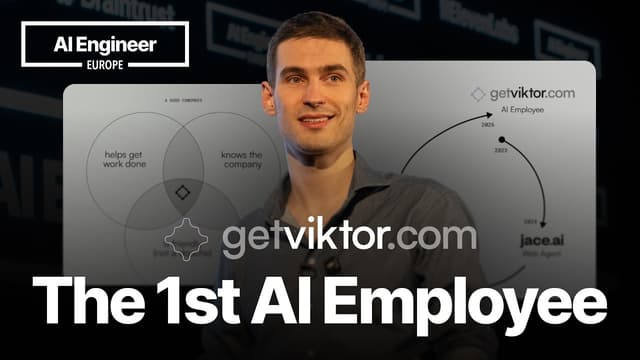
Fryderyk's startup history embodies the evolution of AI agent implementation across three generations: (1) 2023: JCI (a browser agent, state-of-the-art on the Web Arena benchmark but unreliable); (2) 2024: Jace (pivoting to an email agent with Sonnet 3.5); (3) February 2026: Viktor (the Slack AI employee) launches → immediate PMF.
Viktor's core differentiation is the distinction between "company agent and personal agent." Claude Cowork and ChatGPT are personal agents; Viktor is a company agent that holds company-wide context. The design — "one person connects an integration, and the whole team uses it" (06:00) — reads as the establishment of a new product category in the LLM market.
From MEMEX's editorial perspective, what matters is that this is the first article to give an organizational-structure treatment of company agents in 3D. Tavoon covers "embedding coding agents in your own product"; Viktor covers "hiring company agents like employees." The two complement each other from different angles on the question of "AI inside the company."
Key Observations
Three generations of agents — JCI → Jace → Viktor (02:00 - 05:30)
Fryderyk's startup history. In 2023 he built JCI (a browser agent). "Back in 2023, there was no tool calling, no good code generation, so the browser was the interface that could work" (02:20). JCI did lossless DOM snapshot minification and decided the next step.
JCI's limits: "Functional at 60% reliability over 3–5 steps, compounding per step. But state of the art, top of the Web Arena benchmark" (03:30). "We couldn't make it a real product — reliability and speed problems" (03:50).
2024: pivot to Jace. Sonnet 3.5 had arrived and tool calling was good. Jace is an email agent. "Instead of going to a web app, the agent moves proactively with the necessary context" (04:30). Got to PMF; "it's still alive."
February 2026: Viktor. "Not a personal agent — a company agent" (05:30). "We always wanted to build an employee."
Company agent vs personal agent (05:30 - 06:30)
Viktor's core differentiator. "With a personal agent, everyone in the company connects integrations themselves and runs the agent themselves. With a company agent it's different — one person connects an integration, Viktor inherits the permissions, and the whole team uses it" (06:00).
This gives:
- 3,000 integrations (via Pipedream)
- Cross-cutting company-wide context — a universal PhD-level understanding in which a CMO can access the codebase
- If an integration is missing, Viktor can build the connection itself
"Why Slack" — two underlying reasons (08:21 - 09:35)
Fryderyk's argument. (1) "We want Viktor to feel like a human employee. People don't talk to a human employee in a web app, they talk in Slack" (08:30).
(2) The psychological softening of latency. "If Viktor is powerful, a task takes 10 minutes. Going to a web app and waiting 10 minutes is frustrating — ChatGPT does it in 30 seconds. But waiting 10 minutes for a coworker to reply in Slack is normal, even fast — no coworker can build you an app in 10 minutes" (09:00 - 09:35).
This is a deep UX insight. "The same 10 minutes feels different in a different context" — that psychological softening is built into the product architecture.
"Tone matters" — Opus 4.6 vs GPT 5.4 (12:10 - 12:55)
An unexpected finding behind why Opus 4.6 is Viktor's main model. "We tried GPT 5.4 on tool calling + code gen — actually great, and cheap. But we didn't switch, because of personality" (12:20).
Concretely: "Users love Opus; on the A/B test, everyone was furious" (12:30). "Opus is a little sassy, and that's kind of funny inside Viktor" (12:50).
This is empirical evidence that Amanda Askell's Claude character design and the "Claude is a weird egg" insight carry real production business impact. The work of Anthropic's Personality Alignment team is directly affecting the retention of third-party products. A scene in which "the strategic value of Anthropic's character design" is empirically validated against a rival product (GPT).
"Memory fills 100× faster" (06:38 - 07:00)
A structural challenge of company agents. "We worried with OpenCloud (Claude Cowork) that memory fills with time. But imagine the same architecture, the same memory, with 100 users instead of one. Memory drains 100× faster" (06:38 - 07:00).
Read alongside Arize's hierarchical memory strategy, the same problem (LLM context constraints) is being handled at different scales (individual vs 100-person team). The industry's convergence direction is the same — hierarchical memory + sub-agents.
The Slack context-leakage problem — permissions across channels (07:24 - 08:09)
A challenge specific to Viktor. "Slack has different channels; a company has hierarchies. Viktor is in the growth channel, also in the engineering channel, also in DMs. We need to design it so growth context doesn't leak to engineering or support" (07:24).
A concrete example: "When you discuss a problem in DMs, if you're not on the growth team, Viktor won't pull the growth context." This sits alongside the "individual-user compliance vs collective influence" discussion at Anthropic's Alignment Salon as a structural safety problem of multi-agent systems.
The "personal email leak" episode (15:30 - 16:50)
The most visceral use-case episode. "At the largest US e-commerce brand, the admin connected Viktor, and the first team integration was a personal Gmail. Employees started talking to Viktor about the admin's emails. The admin messaged me — 'what are you doing? Viktor is leaking all the data'" (15:30 - 16:00).
Fryderyk's response: "When you hire a new employee, do you give them access to your personal email? You wouldn't" (16:20). This was the trigger to add integration scoping — a design where "personal integrations are used only when summoned in personal DMs."
This is the classic failure mode of multi-user AI products in operation: the gap between user intuition (= same as a human employee) and the implementation default (= all data shared). The response — "scope finely" — runs parallel to Anthropic's Permission layer A mechanism in multi-user AI products that splits permissions and access scope per user or per context. Examples: Claude Code's hooks; authorization controls across Anthropic products in general. Bridges the gap between an individual user's expectations and the AI's ability to access all data. concept.
Three pillars and Leibniz (17:00 - 18:30)
Fryderyk's three pillars for building an AI coworker:
- Helps get work done: now that the models are capable, connect integrations via Pipedream
- Knows the company: leverage context from Slack, get beyond Slack's approval processes (hard but important)
- Make it friendly: a team that likes Viktor, a Viktor that likes the team — personality design
In closing, he quotes Leibniz (17th-century co-inventor of calculus): "Leave it to the machines, and don't lose your time like a slave to the labor of calculation." "Leibniz wanted to build a calculator — but cognitive tasks aren't only calculation. We are at the moment where almost every cognitive task can be automated; we can be part of the revolution" (18:30). A 17th-century vision realized in 2026 — a historical framing. Stands alongside Boris Cherny's "printing press analogy" as a historical-time-axis framing from an industry leader.
Related Articles
- Tavoon: A Piece of Pi — same Code Summit, architectural treatise on enterprise agents
- Arize: Hierarchical Memory — a parallel answer to the memory problem in multi-user settings
- Amanda Askell: AI Personality — the upstream of Opus's personality design
- Amanda: Consciousness — "Claude is a weird egg," directly connected to Viktor's sassy character
- Boris Cherny: The Printing Press Analogy — historical-framing parallel
Key Quotes
- "We are at a beautiful moment in history, in which almost every cognitive task can be automated" (18:30)
- "Leibniz: leave it to the machines, and don't lose your time like a slave to the labor of calculation" (18:50, the 17th-century vision)
- "One person connects an integration, Viktor inherits the permissions, and the whole team uses it" (06:00, the core of the company agent)
- "People don't talk to a human employee in a web app, they talk in Slack" (08:30, the reason for choosing Slack)
- "No coworker can build you an app in 10 minutes, so waiting 10 minutes in Slack feels fast" (09:30, psychological softening of latency)
- "Users love Opus; on the A/B test against GPT 5.4 everyone was furious" (12:30, the production impact of personality)
- "Opus is a little sassy, and that's kind of funny inside Viktor" (12:50)
- "Same architecture, with 100 users memory drains 100× faster" (06:38)
- "Viktor isn't a tool — it's a hire" (15:00, from the personal email leak episode)
- "When you hire a new employee, do you give them access to your personal email? You wouldn't" (16:20)
Video Outline
- (00:00) Self-introduction, Viktor's immediate PMF
- (00:45) Viktor = AI employee, lives in Slack, 3,000 integrations, company-wide context
- (02:00) Past history — 2023, JCI (browser agent)
- (03:30) JCI's limits — 60% reliability, compounding per step
- (04:00) 2024, Jace (email agent on Sonnet 3.5)
- (05:30) February 2026, Viktor launches
- (05:30) Company agent vs personal agent
- (06:00) One connect → everyone has access
- (06:38) Memory challenge — fills 100× faster
- (07:24) The context-leakage problem across Slack channels
- (08:21) "Why Slack" — two reasons (humanlike feel + latency softening)
- (10:22) Slack-specific interaction modes — DMs, channels, threads, emoji reactions, edits
- (12:10) Opus 4.6 vs GPT 5.4 — staying with Opus for personality
- (13:00) Proactive workflow suggestions — A/B test statistical verification with PostHog
- (14:30) The value of shared context — contrast with Claude Code vs Cowork
- (15:30) The personal email leak episode — origin of the integration scoping feature
- (17:00) Three pillars — get work done / knows the company / friendly
- (17:30) Future vision — every company has an AI employee
- (18:00) The Leibniz quote (17th-century vision)
- (18:30) Call to be part of the revolution
- (19:00) Sign-up CTA, $100 in free credits
Sources
Viktor: AI Coworker That Lives in Slack — AI Engineer official (YouTube)
Related resources:
- Viktor official
- Jace official (Viktor's predecessor)
- Pipedream (the integration platform Viktor uses)
Glossary
- Viktor
- The AI employee product co-founded by Fryderyk Wiatrowski. Lives in Slack, has 3,000 integrations (via Pipedream), holds company-wide context, and executes work. Launched in February 2026, with immediate product/market fit and global adoption. Uses Opus 4.6 as its primary model.
- Company Agent vs Personal Agent
- Fryderyk's market segmentation for LLM products. Personal agents (Claude Cowork, ChatGPT) require each user to connect integrations and operate individually. Company agents (Viktor) inherit permissions once one person connects, and the whole team uses them. A "hire it like an employee" mental model.
- JCI (top of the Web Arena benchmark)
- The browser agent Fryderyk built in 2023. With no tool calling at the time, it worked by minifying DOM snapshots and deciding the next step. Top of the Web Arena benchmark, 60% reliability over 3–5 steps. Later evolved into Jace (the email agent).
- Jace
- The email agent Fryderyk's team rebuilt in 2024 on Sonnet 3.5. Instead of going to a web app, the agent proactively holds the context it needs. "When an email arrives the agent is triggered, replies via tools (refund, etc.)." Still alive today. Viktor is the successor.
- Pipedream
- An integration platform with 3,000+ services. Used by Viktor as its integration base. A single connect provides access to many services.
- Personal email leak episode
- At the largest US e-commerce brand, an admin connected a personal Gmail as Viktor's first team integration, and employees could refer to that personal mail's contents via Viktor. This triggered the addition of "integration scoping" (personal integrations are used only when summoned in personal DMs).
- Permission layer
- A mechanism in multi-user AI products that splits permissions and access scope per user or context. Viktor's channel-aware context filtering, integration scoping, and the like. An important pattern that restricts the LLM's state of "technically having access to all data" to "the range a user expects."